
Why Colorectal Cancer Screening Matters
Colorectal cancer is the second leading cause of cancer death in the United States when men and women are considered together, according to the American Cancer Society. The encouraging reality is that it is also one of the most preventable cancers — when detected early, survival rates improve dramatically. Screening doesn't just catch cancer; several methods can identify and allow removal of precancerous polyps before they ever become malignant.
Current guidelines from the U.S. Preventive Services Task Force (USPSTF) recommend that average-risk adults begin screening at age 45 and continue through age 75. Decisions beyond 75 should be individualized with a provider. For a broader view of how colorectal screening fits into overall preventive care, see screenings with the strongest clinical evidence.
Comparing the Main Screening Options
Several methods are endorsed by major clinical bodies, each with distinct trade-offs in sensitivity, convenience, preparation burden, and follow-up requirements. Understanding what each involves helps frame an informed conversation with a healthcare provider.
| Colonoscopy | FIT | FIT-DNA | CT Colonography | Flexible Sigmoidoscopy | |
|---|---|---|---|---|---|
| Screening interval | Every 10 years | Annually | Every 1–3 years | Every 5 years | Every 5 years |
| Bowel prep required | Full prep | None | None | Full prep | Partial prep |
| Detects polyps directly | Yes | No | No | Yes (imaging) | Lower colon only |
| Can remove polyps | Yes | No | No | No | Sometimes |
| Sedation needed | Yes | No | No | No | Usually not |
| Positive result requires colonoscopy | N/A | Yes | Yes | Yes | Yes |
| Setting | Clinic/hospital | At home | At home | Radiology facility | Clinic |
The table above reflects general characteristics; individual coverage, health history, and access to facilities all influence which option is most practical for a given person.
Stool-Based Tests: Convenient but Requiring Follow-Up
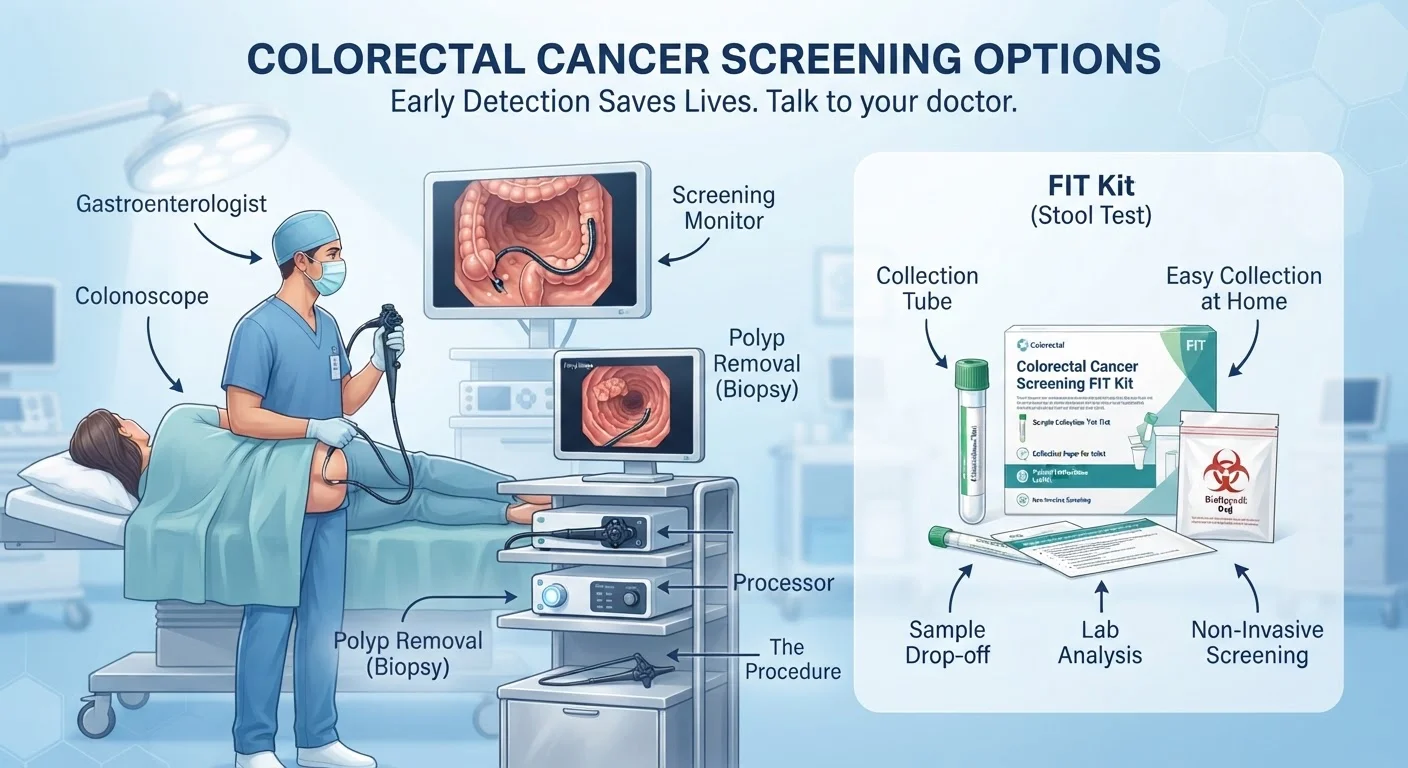
Stool-based tests are non-invasive and can be completed at home, making them an attractive entry point for many people. The three main types are:
- Guaiac Fecal Occult Blood Test (gFOBT): Detects blood in stool using a chemical reaction. Requires annual testing and dietary restrictions before sample collection.
- Fecal Immunochemical Test (FIT): Also detects hidden blood but uses antibodies specific to human hemoglobin, requiring no dietary restrictions. Recommended annually.
- FIT-DNA (multitarget stool DNA test): Combines FIT with detection of abnormal DNA shed by colorectal cells. Recommended every one to three years. More sensitive for cancer detection but also has a higher rate of false positives compared with FIT alone.
A critical point: a positive stool test result must be followed up with a diagnostic colonoscopy. The stool test is a screening tool — colonoscopy is needed to visualize and, if necessary, remove any abnormality found.
Colonoscopy: The Reference Standard
Colonoscopy allows a gastroenterologist to directly view the entire colon and rectum using a flexible, camera-equipped tube. It is the only screening method that both detects and treats polyps in a single procedure — detected polyps are typically removed immediately during the exam.
For average-risk individuals with a normal result, screening intervals extend to 10 years. The main burdens are the bowel preparation the day before (a clear-liquid diet and laxative regimen), the need for sedation, and arranging transportation. Rare but serious complications, including perforation and bleeding, do occur, though their incidence is low in routine screening populations.
Men should be aware that colorectal cancer risk rises with age — see age-appropriate screenings for men for context on when and why this matters.
CT Colonography and Flexible Sigmoidoscopy
CT Colonography (Virtual Colonoscopy): Uses computed tomography imaging to create detailed three-dimensional images of the colon. Bowel prep is still required, and no sedation is needed. If a polyp or suspicious area is found, a standard colonoscopy must be scheduled. Recommended every five years for average-risk individuals where available.
Flexible Sigmoidoscopy: A shorter scope examines only the lower third of the colon (the sigmoid colon and rectum). It typically requires only a partial bowel prep and no sedation. Because it does not visualize the entire colon, it may miss lesions in the upper sections. Recommended every five years, sometimes combined with annual FIT.
This article is for general health information and education, not personal medical advice. Speak with a qualified healthcare provider about which colorectal cancer screening approach is appropriate for your individual health history, risk factors, and circumstances.