Why the Distinction Matters
Most of us use "stress" and "anxiety" interchangeably — and it makes sense why. Both can make your heart race, your sleep suffer, and your concentration slip. But treating them as identical can lead you toward coping tools that don't quite fit, leaving you frustrated when the relief doesn't come.
Stress and anxiety share the same biological alarm system — the body's fight-or-flight response — but they differ in their origins, their timelines, and how they respond to intervention. Understanding those differences is the first step toward choosing strategies that actually help. For a deeper look at the biology behind both, our practical glossary of stress and anxiety terms explains key concepts like cortisol and the amygdala in plain language.
What Stress Actually Is
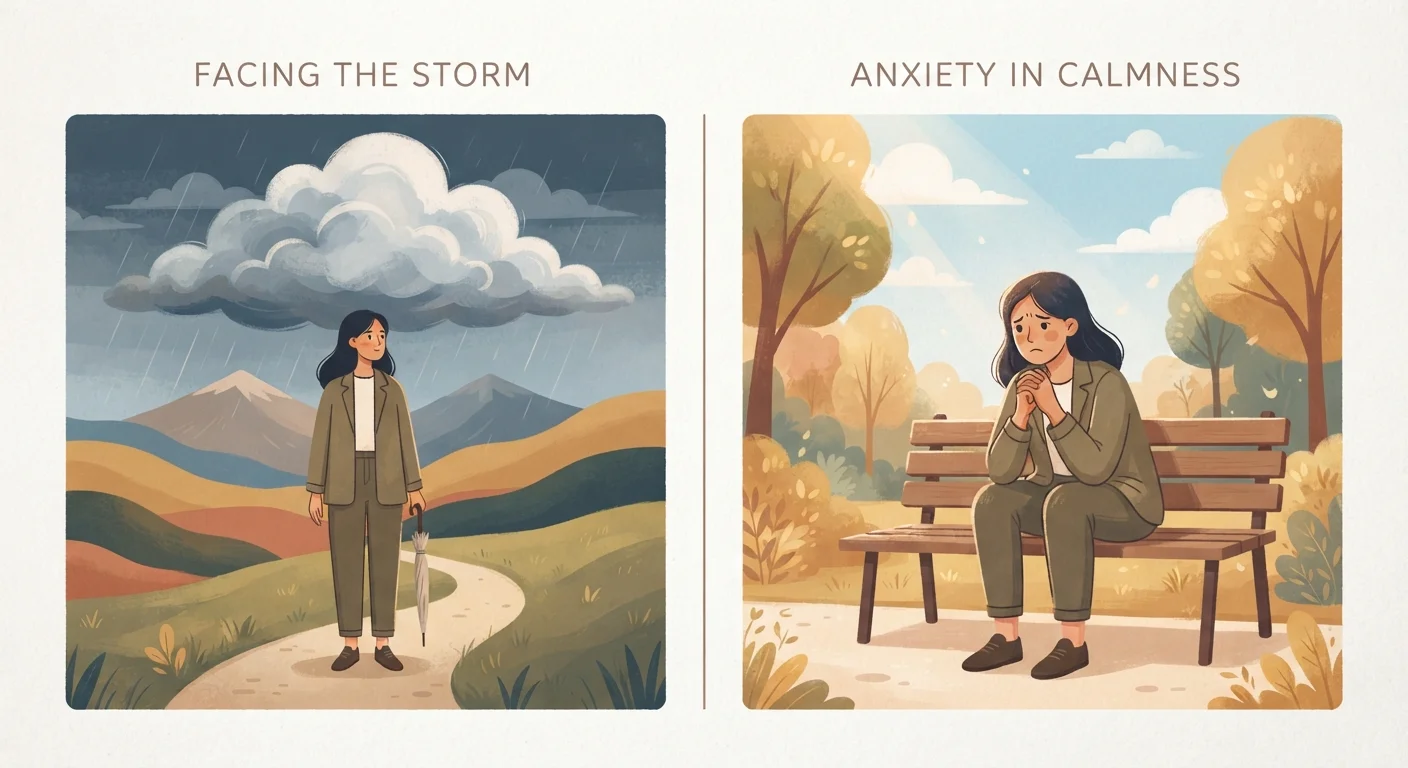
Stress is a response to an external demand or pressure — something identifiable in your environment. A looming work deadline, a difficult conversation, financial strain, or physical illness can all trigger stress. Psychologists often describe this as a stimulus-response model: there is a stressor, and your body and mind react to it.
Critically, stress tends to be time-limited. Once the stressor resolves — the deadline passes, the conflict gets addressed — the stress response typically winds down. This is why problem-focused coping, meaning taking direct action to address the source of pressure, is often effective for stress.
That said, when stressors pile up or never fully go away, stress can become chronic. Chronic stress carries its own health implications that differ from a single intense episode. Our article on acute vs. chronic stress explores how the duration of stress shapes its effects on the body.
| Criterion | Stress | Anxiety |
|---|---|---|
| Primary trigger | Identifiable external stressor | Internal worry, often anticipatory |
| Duration | Typically resolves with stressor | Can persist without clear cause |
| Focus | Present or recent event | Future threat, real or imagined |
| Cognitive pattern | Problem-oriented thinking | Rumination and catastrophizing |
| Effective coping approach | Problem-focused action | Cognitive and mindfulness strategies |
| When to seek help | If stress becomes chronic | If worry is hard to control or disabling |
What Anxiety Actually Is
Anxiety is often described as worry or fear that is future-oriented and may persist even when no clear threat is present. Rather than reacting to something happening now, anxiety involves anticipating something that might go wrong. The threat feels real and urgent — but it may be exaggerated, vague, or entirely hypothetical.
This is where anxiety diverges meaningfully from stress. Removing the external stressor doesn't resolve anxiety the way it resolves stress. Someone with anxiety may worry intensely on a calm, uneventful day. This persistent, hard-to-control quality is one of the hallmarks clinicians look for when evaluating anxiety disorders.
Anxiety also tends to involve cognitive patterns like rumination (replaying worries repeatedly) and catastrophizing (assuming the worst outcome). These patterns can sustain the anxiety cycle independently of what's happening in the outside world. Our whole-person perspective on stress and anxiety examines how psychological, physical, and environmental factors interact to shape both experiences.
Choosing the Right Response
Once you recognize which experience you're dealing with, you can match your approach more precisely.
For stress, strategies that address the source tend to work well: breaking a large task into manageable steps, setting boundaries, improving sleep, or reaching out for practical support. Stress management techniques focused on relaxation and time management can also buffer the body's stress response during demanding periods.
For anxiety, the goal shifts. Because anxiety is driven more by internal thought patterns than external events, approaches that work with the mind directly tend to be more effective. Cognitive-behavioral strategies — identifying and gently challenging distorted thoughts — have a strong evidence base. Mindfulness practices can also help by training attention toward the present moment rather than hypothetical futures. Our comparison of CBT vs. mindfulness-based stress reduction for anxiety breaks down how these two well-studied approaches differ.
It's also worth noting that how you respond in the moment matters. Reacting vs. responding to difficult emotions may look similar in the heat of the moment, but the outcomes diverge significantly over time.
If anxiety feels persistent, uncontrollable, or is interfering with your work, relationships, or daily routines, speaking with a licensed mental health professional is an important step — not a last resort.
This article is for general informational and educational purposes only and is not a substitute for professional medical or mental health advice. Always consult a qualified healthcare provider with questions about your mental health.