Why Your Breath Is a Direct Line to Your Nervous System
Unlike your heart rate or digestion, your breathing sits at a rare crossroads: it runs automatically, yet you can also control it deliberately. That dual nature gives breathing unusual power. When you slow and deepen your breath consciously, you send a signal through the vagus nerve — the body's primary parasympathetic highway — that tells your brain the threat has passed and it is safe to relax.
Research published in journals such as Frontiers in Human Neuroscience and Psychophysiology has documented measurable reductions in heart rate, cortisol, and self-reported anxiety following structured breathing practice. For a deeper look at the underlying physiology, see our guide to how controlled breath calms the nervous system.
The techniques below vary in rhythm and complexity, so you can choose whichever fits your moment — whether you have two minutes at your desk or fifteen minutes before bed.
Start Small and Build Gradually
If you're new to breathwork, even two to three minutes of intentional slow breathing can make a meaningful difference. You don't need a dedicated meditation space or special equipment — a parked car, a quiet hallway, or a few minutes at your desk all work. As the practice feels more natural, gradually extend your sessions and experiment with different techniques to find what resonates with you.
Evidence-Supported Breathing Techniques to Try
Diaphragmatic (Belly) Breathing
Diaphragmatic breathing — sometimes called belly breathing or abdominal breathing — is the foundation most other techniques build on. Instead of shallow chest breathing, you engage your diaphragm so your belly rises on the inhale and falls on the exhale.
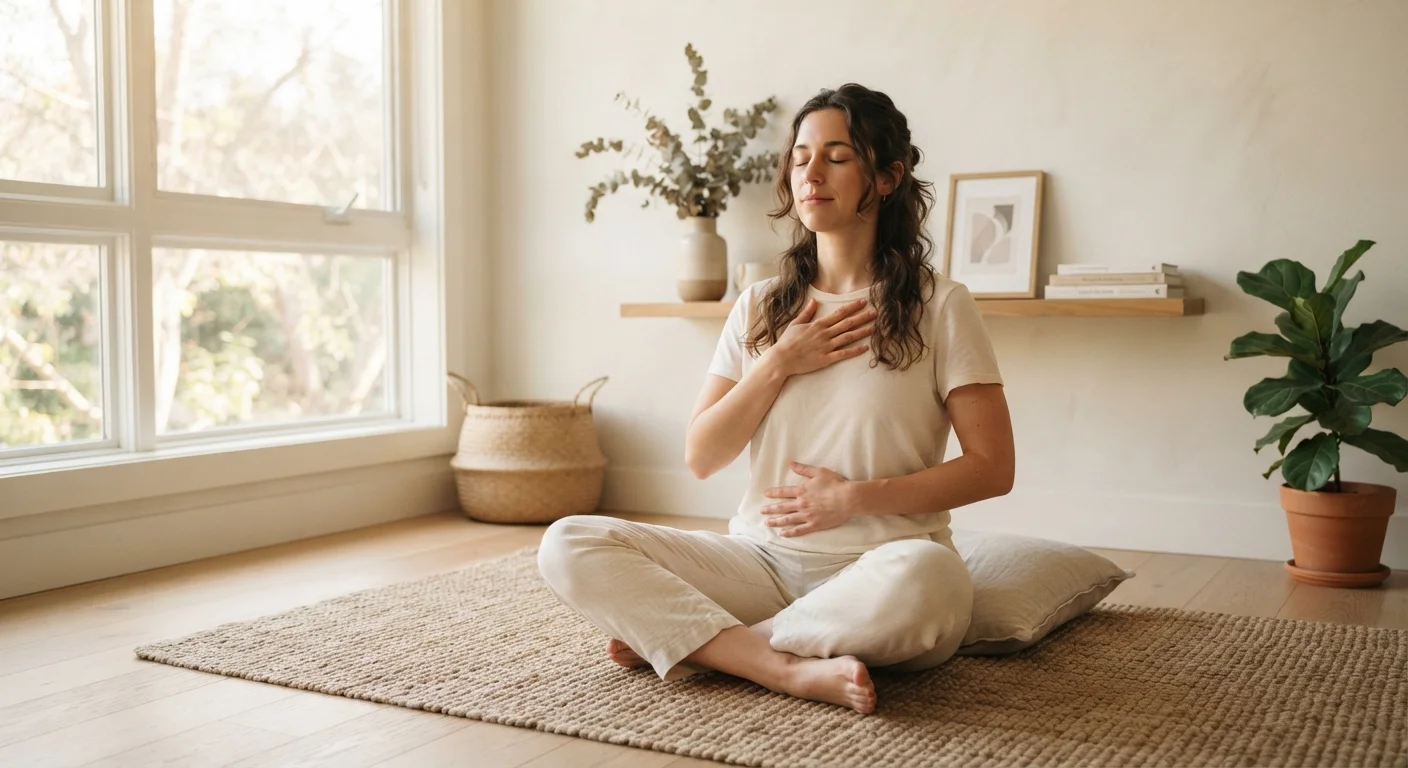
Studies, including a 2017 trial in Frontiers in Psychology, found that participants trained in diaphragmatic breathing showed significantly lower cortisol levels and sustained attention improvements compared to a control group. To practice, place one hand on your chest and one on your belly. Inhale slowly through the nose for about four counts, letting the belly hand rise while the chest stays relatively still. Exhale fully for four to six counts. Even five minutes can shift your physiological state noticeably.
Diaphragmatic breathing lowers cortisol and shifts the body out of its stress response.
Box Breathing (4-4-4-4)
Box breathing — inhale for four counts, hold for four, exhale for four, hold again for four — is used by military and emergency personnel precisely because it works under high-pressure conditions. The structured pattern gives an activated mind something concrete to focus on while simultaneously slowing the breath rate.
Research on slow-paced breathing with breath holds supports its ability to increase heart rate variability (HRV) — a measure of the nervous system's flexibility and resilience. Higher HRV is consistently linked to better emotional regulation. Box breathing is particularly useful during acute stress because its simple symmetry is easy to remember when you're not thinking clearly.
Box breathing's structured rhythm gives an anxious mind a concrete focus while calming the body.
4-7-8 Breathing
Popularized in clinical discussions of relaxation training, the 4-7-8 pattern involves inhaling for four counts, holding the breath for seven, and exhaling slowly for eight. The extended exhale is the key: a longer out-breath relative to the in-breath shifts the balance toward parasympathetic activity more reliably than equal-ratio breathing.
While large-scale randomized trials specifically on 4-7-8 breathing are still limited, the physiological mechanism — prolonging exhalation to activate the vagal brake on heart rate — is well established in the broader breathwork literature. Many practitioners find it especially effective as a pre-sleep technique; our article on evidence-informed relaxation for the hour before bed covers how to integrate it into a bedtime routine.
A longer exhale relative to the inhale is the physiological key that unlocks the calming response.
Resonance (Coherent) Breathing
Resonance breathing, often called coherent breathing, involves breathing at a rate of roughly five to six full breath cycles per minute — typically a five-second inhale followed by a five-second exhale. This slow cadence is thought to synchronize breath, heart rate, and blood pressure fluctuations in a way that maximizes vagal tone.
Studies using HRV biofeedback — a related technique — have shown reductions in anxiety and depression symptoms, and some research suggests even unassisted resonance breathing produces similar physiological signatures. A 2018 meta-analysis in Applied Psychophysiology and Biofeedback found HRV biofeedback reliably reduced self-reported stress and anxiety across diverse populations. Resonance breathing is a good option for longer, more deliberate practice sessions rather than quick interventions.
Breathing at five to six cycles per minute appears to maximize the body's natural calming rhythm.
Alternate Nostril Breathing (Nadi Shodhana)
Rooted in yogic tradition but increasingly studied in clinical settings, alternate nostril breathing involves using your fingers to close one nostril at a time while alternating the side through which you inhale and exhale. Research published in journals such as International Journal of Yoga has found it associated with reduced heart rate, blood pressure, and perceived stress.
A small but growing body of evidence suggests it may also support cardiovascular and respiratory function. Close your right nostril with your thumb, inhale through the left, then close the left with your ring finger, release the right, and exhale through it — then reverse. One complete round takes about 10–20 seconds. Five minutes of practice is generally sufficient to notice a calming effect. For a side-by-side comparison of relaxation methods, including this one, we've compiled a full breakdown.
Alternate nostril breathing has shown measurable reductions in heart rate and perceived stress in clinical studies.
Making Breathwork Part of Your Routine
A single session of slow breathing can blunt an acute stress response, but research consistently shows that regular practice deepens the benefit over time. Your nervous system appears to learn — repeated activation of the parasympathetic response gradually lowers your baseline arousal level and improves stress recovery speed.
If you're looking to build a broader calming routine, breathwork pairs naturally with other evidence-informed strategies. Our article on building a daily wind-down routine to lower background anxiety offers a practical framework, and if you're comparing options, this comparison of breathing, meditation, and movement can help you identify what fits your life. For moments when emotions feel especially intense, grounding techniques can work alongside breathwork to bring you back to the present.
This article is for general informational and educational purposes only and is not a substitute for professional medical or mental health advice. If you experience persistent anxiety, panic attacks, or other mental health concerns, please consult a qualified healthcare provider.