How Sleep Is Structured: A Quick Orientation
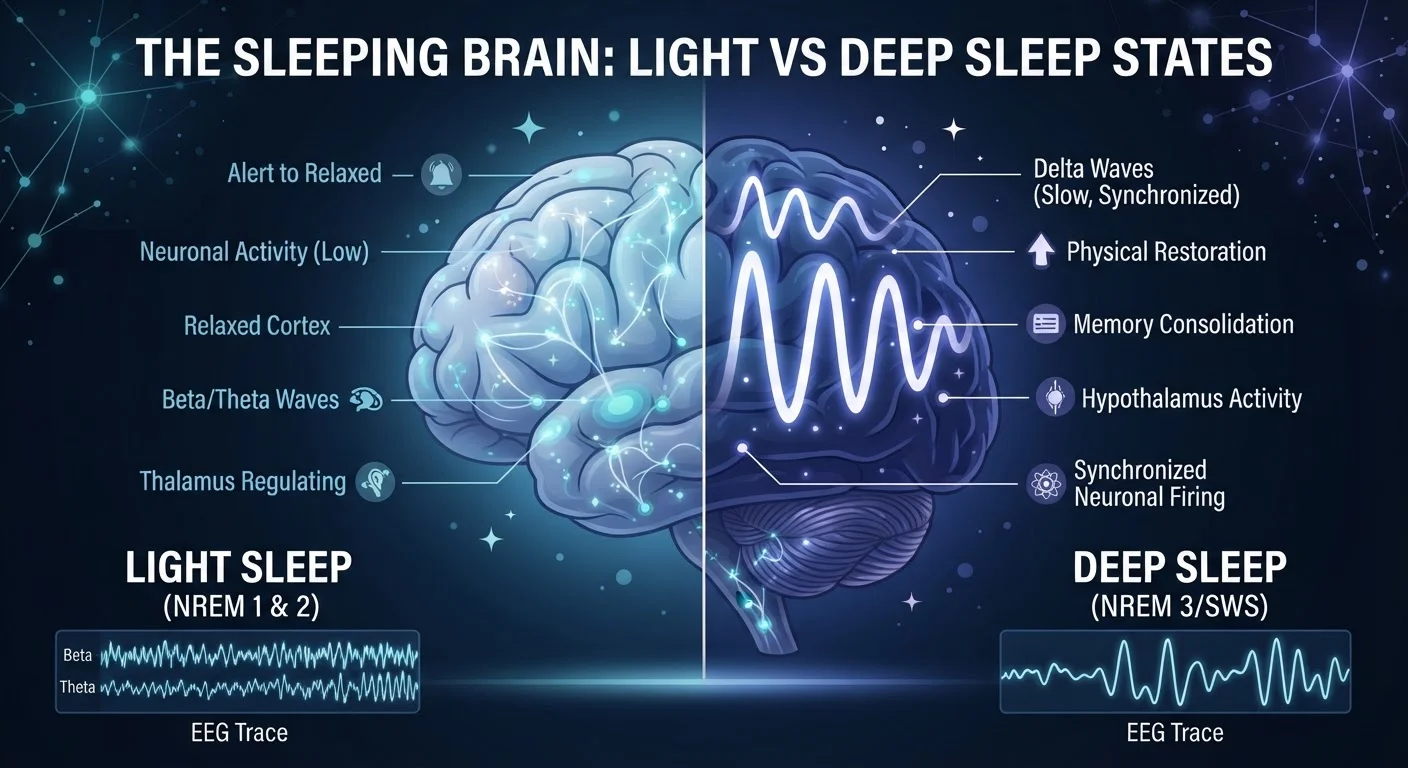
Sleep is not a uniform state. Each night, your brain cycles through four distinct stages — three non-REM (NREM) stages and one REM stage — repeating roughly every 90 minutes. Light sleep refers to NREM Stages 1 and 2, while deep sleep corresponds to NREM Stage 3, also called slow-wave sleep. For a full picture of how all four stages fit together, see Sleep Stages Explained.
Each stage serves a different biological purpose, and healthy sleep requires cycling through all of them. The balance shifts across the night: deep sleep dominates the early cycles, while light sleep and REM sleep are more prominent in the second half. Understanding what distinguishes light from deep sleep helps clarify why how you sleep matters as much as how long you sleep.
What Happens During Light Sleep
Stage 1 light sleep is the brief transition between wakefulness and sleep — lasting only a few minutes per cycle. Your muscle activity slows, your eyes move gently, and you can be easily roused. It accounts for just 5% of total sleep time in most adults.
Stage 2 is where light sleep becomes functionally significant. Brain activity during this stage features characteristic patterns called sleep spindles — rapid bursts of oscillatory neural activity — and K-complexes, large slow waves thought to suppress arousal and protect sleep continuity. Research consistently links sleep spindles to memory consolidation, particularly the kind of procedural and declarative learning that takes place during the day.
Collectively, light sleep fills roughly 50–60% of total nightly sleep. It serves as the connective tissue between deeper stages: your brain repeatedly passes through it as it cycles between deep sleep and REM. While easier to disrupt than deep sleep, Stage 2 is far from passive — it actively maintains your sleep state and primes your brain for the stages that follow.
| Criterion | Light Sleep (NREM 1 & 2) | Deep Sleep (NREM 3) |
|---|---|---|
| % of total sleep | 50–60% | 15–20% |
| Brain wave type | Theta waves, spindles, K-complexes | Delta waves (slow-wave) |
| Ease of arousal | Easily awakened | Very difficult to wake |
| Primary function | Memory consolidation, sleep continuity | Physical repair, immune support, hormone release |
| When most concentrated | Throughout night, especially later cycles | First third of the night |
| Disrupted by | Noise, stress, irregular schedules | Alcohol, aging, sleep deprivation, environment |
What Happens During Deep Sleep
NREM Stage 3 — deep sleep or slow-wave sleep — is defined by the dominance of delta waves, the slowest and highest-amplitude brain waves measured during sleep. Physiologically, this is when your body is doing its heaviest lifting.
During deep sleep, the pituitary gland releases the majority of the night's growth hormone, which drives tissue repair, muscle recovery, and cellular regeneration. The immune system is also highly active during this phase, producing cytokines that help the body respond to infection and inflammation. Blood pressure drops, breathing slows, and the brain essentially goes offline from processing the outside world — which is why people roused from deep sleep often feel confused and groggy, a phenomenon called sleep inertia.
Deep sleep is hardest to obtain and easiest to lose. Sleep deprivation, alcohol consumption, aging, and poor sleep environments all disproportionately reduce this stage. Adults typically spend 15–20% of total sleep time in deep sleep, with that proportion declining naturally with age. To understand how your environment influences access to this phase, see Your Bedroom Environment and Sleep Quality.
Key Differences — and Why Both Matter
The most practical distinction is this: light sleep keeps you asleep and supports cognitive function, while deep sleep restores your body. Sacrificing either has measurable consequences. Chronic reduction in deep sleep is associated with impaired immune response, metabolic disruption, and increased cardiovascular risk. Insufficient light sleep disrupts the sleep cycles that allow deep sleep and REM sleep to occur at all.
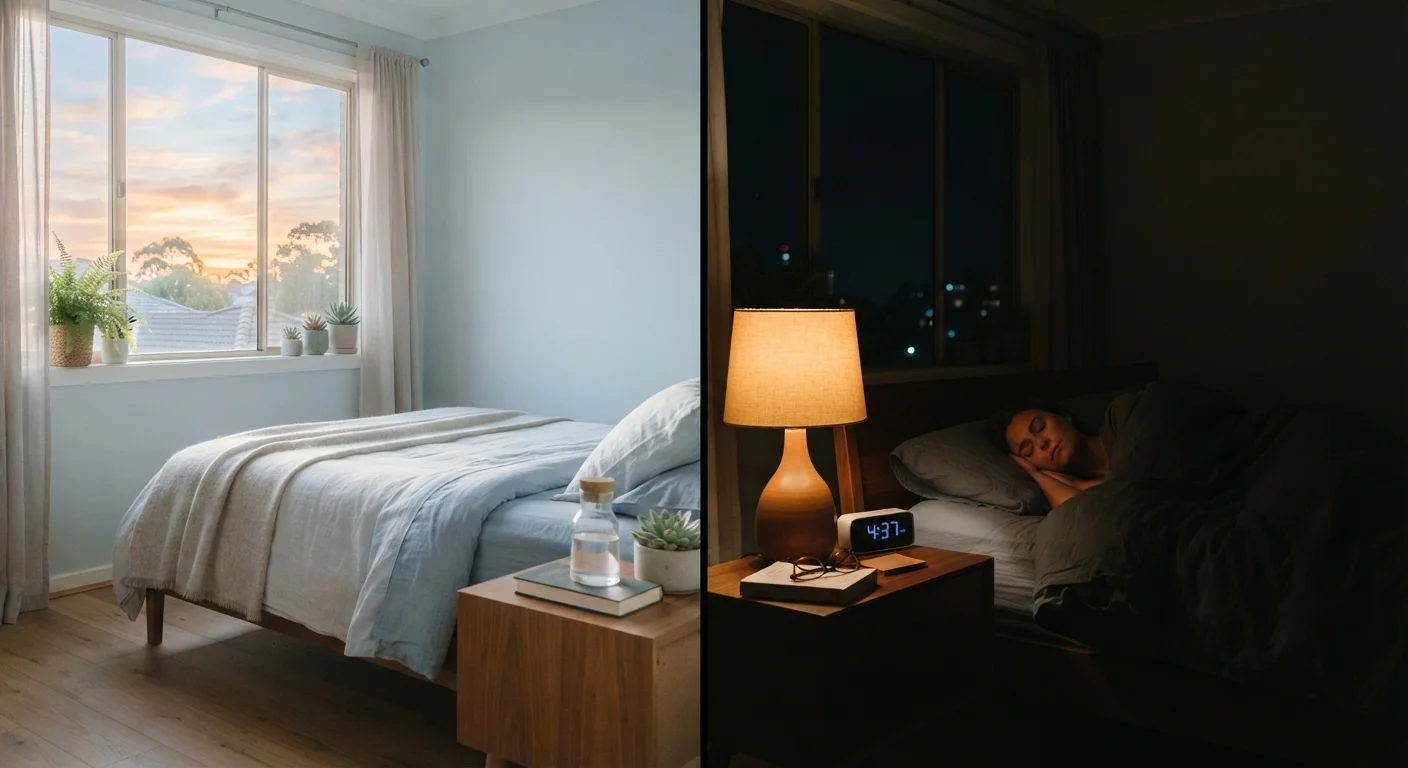
Notably, both stages are impaired by the same upstream problems — irregular sleep timing, excess light exposure at night, and chronic stress. Morning and evening light exposure plays a direct role in regulating the sleep architecture that determines how much of each stage you get. If you're unsure whether your sleep difficulties reflect a behavioral pattern or something more clinical, understanding the difference between insomnia and sleep deprivation is a useful starting point.
This article provides general health information and is not a substitute for professional medical advice. If you have concerns about your sleep health, consult a qualified healthcare provider.