What Sets Them Apart: Mechanism Matters
Both central sleep apnea (CSA) and obstructive sleep apnea (OSA) involve repeated pauses in breathing during sleep — sometimes dozens or even hundreds of times a night. Despite this shared outcome, the cause in each case is fundamentally different, and that difference shapes how each condition is recognized, diagnosed, and managed.
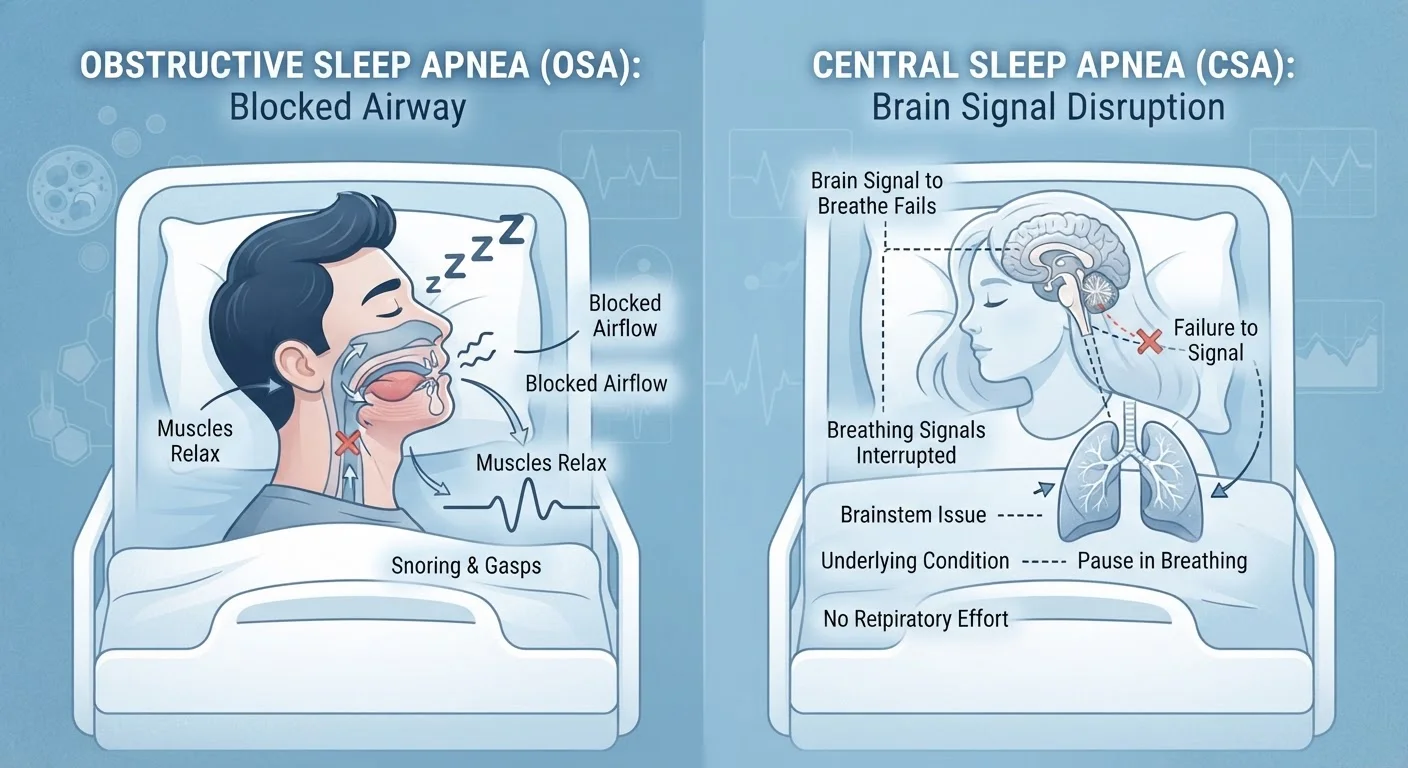
With obstructive sleep apnea, the problem is mechanical. Soft tissue in the throat — the tongue, tonsils, or the muscles lining the airway — relaxes too much during sleep and physically blocks airflow. The brain continues sending the signal to breathe, and the chest and abdomen keep trying to move, but air cannot get through. The result is often an audible snore, gasp, or choking sound as the body forces its way past the obstruction.
With central sleep apnea, the airway itself is unobstructed. Instead, the brain temporarily fails to send the correct signals to the respiratory muscles. There is no physical barrier — the body simply doesn't receive the instruction to breathe. Because the effort to breathe also stops, CSA events tend to be quieter and are less likely to cause the dramatic snoring associated with OSA.
Sleep disorders explained covers the broader landscape of conditions that interfere with rest, including where both forms of sleep apnea fit within clinical classifications.
| Criterion | Central Sleep Apnea (CSA) | Obstructive Sleep Apnea (OSA) |
|---|---|---|
| Primary cause | Brain fails to signal breathing muscles | Physical airway blockage during sleep |
| Breathing effort during pause | Absent — no chest movement | Present — chest and abdomen still try |
| Snoring | Often absent or mild | Typically loud and frequent |
| Prevalence | Uncommon (minority of cases) | Common (majority of sleep apnea cases) |
| Common associations | Heart failure, stroke, opioid use | Excess weight, anatomical airway traits |
| Primary treatment | Treat underlying condition; ASV in some cases | CPAP therapy; lifestyle modifications |
| Diagnosis method | Polysomnography (sleep study) | Polysomnography or home sleep test |
Who Is Affected and Why
OSA is significantly more common. Research consistently estimates that OSA accounts for the vast majority of sleep apnea cases in the general population. Risk factors include excess weight around the neck, a naturally narrow airway, nasal congestion, sleeping on one's back, and increasing age. Men are diagnosed with OSA at higher rates than women, though women's risk rises after menopause.
CSA, by contrast, is less prevalent and more frequently tied to underlying medical conditions rather than anatomical traits. Heart failure is one of the most well-documented contributors, particularly a pattern called Cheyne-Stokes respiration, in which breathing rhythmically waxes and wanes. Stroke, brainstem injury, high altitude, and the use of opioid-based medications can all disrupt the brain's respiratory control centers and produce CSA.
A third category — sometimes called complex or treatment-emergent sleep apnea — occurs when central events appear or persist after OSA has been treated with continuous positive airway pressure (CPAP) therapy. This highlights why ongoing clinical follow-up after a sleep apnea diagnosis matters.
For a detailed look at OSA's prevalence and health implications, obstructive sleep apnea's risk factors and consequences are worth reviewing.
When Sleep Apnea Goes Unrecognized
Both CSA and OSA are associated with elevated risks for high blood pressure, heart arrhythmias, and daytime cognitive impairment when left unaddressed. Many people live with sleep apnea for years without realizing it, because nighttime breathing pauses often go unnoticed by the person experiencing them. A bed partner's observations — or recording audio during sleep — can sometimes be the first clue that something warrants clinical attention.
Diagnosis and Management: Different Paths
Because symptoms alone cannot reliably differentiate CSA from OSA, a formal sleep study — polysomnography — is the diagnostic standard. Conducted in a sleep clinic or, in some cases, using a home sleep test for suspected OSA, it monitors airflow, blood oxygen levels, chest effort, and brain activity simultaneously. The data reveal not just whether breathing pauses occur, but whether respiratory effort is present during those pauses — the key distinction between obstructive and central events.
For OSA, CPAP therapy remains the most widely recommended treatment. By delivering a gentle, continuous stream of pressurized air through a mask, CPAP physically holds the airway open. Lifestyle changes — weight management, positional therapy, and addressing nasal obstruction — can also reduce OSA severity.
CSA management is more individualized. Treating the underlying cause, such as optimizing heart failure management or adjusting opioid medications under medical supervision, can reduce or resolve central events in some cases. Adaptive servo-ventilation (ASV) is a specialized ventilatory device sometimes used for certain CSA subtypes, though it is not appropriate for all patients — particularly those with reduced heart function. A sleep specialist works with cardiology, neurology, or other relevant teams to determine the safest approach.
This article is for general informational and educational purposes only and is not a substitute for professional medical advice, diagnosis, or treatment. If you are concerned about your sleep or breathing during sleep, consult a qualified healthcare provider.