
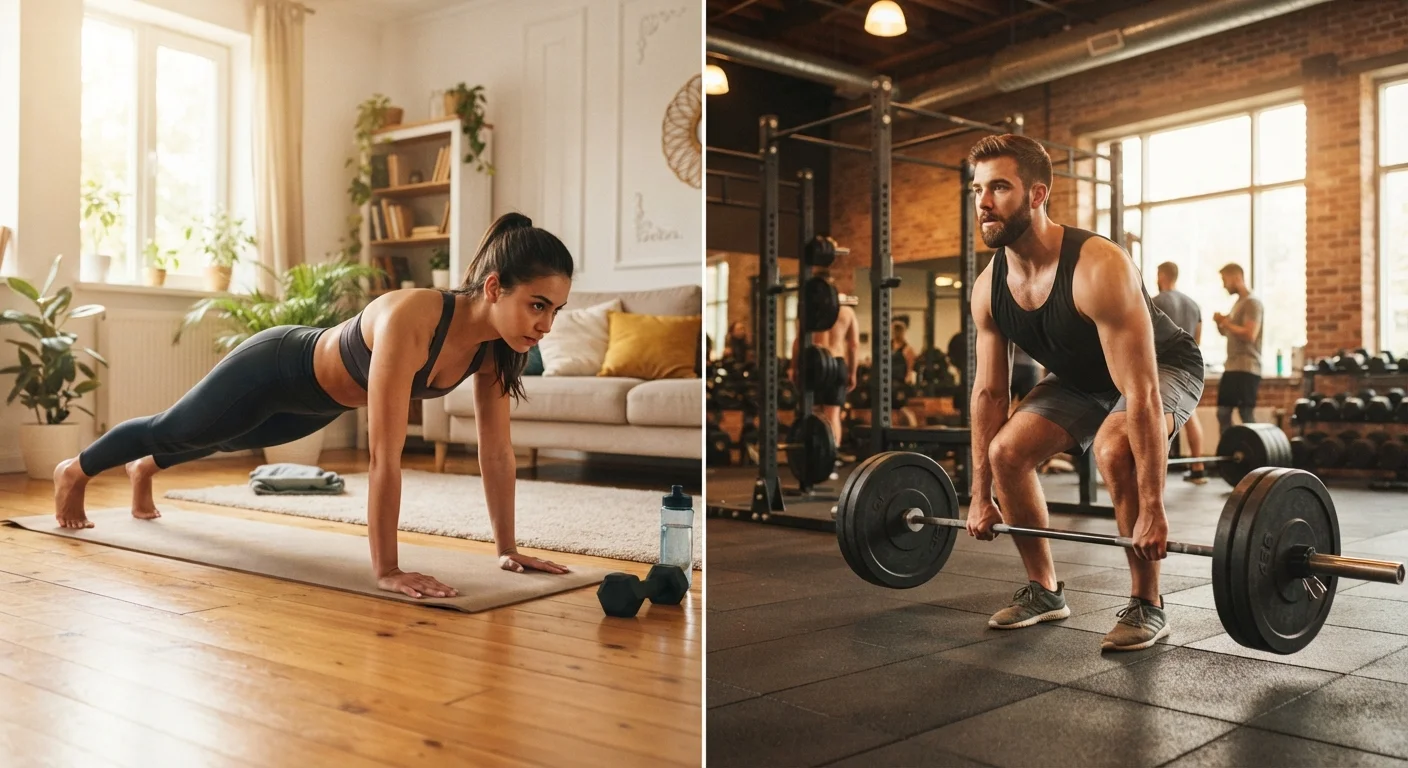
What the Setting Actually Changes
When people debate home versus gym workouts, the conversation often focuses on equipment. That matters, but it's only part of the picture. The environment you train in shapes your habits, your options, and your psychology — not just your tool set.
At a gym, you have access to a wide range of resistance equipment, dedicated cardio machines, open floor space, and often trained staff. That variety makes it easier to follow progressive programming for workout types like heavy barbell training or machine-based rehabilitation work that genuinely requires specific hardware.
At home, your primary advantages are convenience and control. No commute, no wait times for equipment, no membership fees after initial setup. Many people find this friction reduction translates directly into more consistent training — and consistency is the variable that matters most for long-term outcomes.
What doesn't change is the underlying physiology. Your muscles respond to mechanical tension, metabolic stress, and progressive challenge the same way whether you're in your living room or a commercial gym. The stimulus drives the adaptation, not the zip code.
Comparing the Two Environments Side by Side
Understanding where each setting genuinely excels — and where it falls short — helps you make a clear-eyed decision rather than defaulting to assumptions.
| Home Workouts | Gym Workouts | |
|---|---|---|
| Upfront cost | Low to moderate (minimal equipment needed) | Low (membership) to high (premium facilities) |
| Equipment variety | Limited by space and budget | Extensive; machines, free weights, cardio |
| Convenience | Very high; no travel required | Moderate; commute and hours apply |
| Social/accountability factor | Lower; self-directed | Higher; staff, classes, community |
| Suitability for heavy strength training | Moderate; depends on home setup | High; barbells and racks available |
| Flexibility in schedule | Very high; available 24/7 | Limited by facility hours |
| Space required | Minimal to moderate | None at home; gym provides it |
One nuance worth noting: cost comparisons depend heavily on individual circumstances. A gym membership might cost less annually than building a functional home setup with quality resistance equipment. Conversely, a years-long membership compounds in ways a one-time equipment purchase does not. Neither math is universally better.
What Stays Exactly the Same
Regardless of where you train, the fundamental rules of exercise science don't budge. Progressive overload — gradually increasing the challenge placed on your muscles over time — is the engine behind strength and fitness gains in any setting. You can apply it at home with resistance bands, bodyweight progressions, or adjustable dumbbells just as legitimately as with barbells at a gym.
Recovery is equally non-negotiable. Sleep, nutrition, and rest days between hard sessions determine how well your body absorbs the training you put in. No amount of equipment changes that equation. Similarly, the distinction between cardio and strength training and how each stresses the body physiologically doesn't shift based on location.
Warm-up and cooldown practices, the importance of movement variety, and the need to listen to your body for signs of overtraining — all of these apply everywhere. If you're considering low-impact formats, those translate seamlessly between settings, since they rely on movement quality over equipment load.
Making the Decision That Sticks
Research consistently points to adherence as the dominant factor in fitness outcomes. The best workout environment is the one you'll return to week after week. That means your choice should center on honest self-assessment, not idealism.
Ask yourself: Do you need external accountability to stay motivated? Do you thrive in social settings, or do you find gyms distracting? Is your schedule unpredictable enough that a commute-free option would realistically save sessions? Are you pursuing goals — like powerlifting or sport-specific conditioning — that require equipment you can't reasonably replicate at home?
Some people find that splitting their training between both settings provides the best of each: using home sessions for shorter, flexible workouts and the gym for longer, equipment-intensive sessions. You might also find it useful to consider how your workout timing interacts with your setting — when you exercise can affect how practical each option is on any given day.
Whatever you choose, prioritize a setup you can sustain. A modest, consistent effort in a supportive environment will outperform an ambitious plan that fades after three weeks.
This article is for general informational and educational purposes only and is not a substitute for professional medical or fitness advice. Consult a qualified healthcare provider or certified fitness professional before beginning a new exercise program, especially if you have existing health conditions.