Origins and Foundational Philosophy
Pilates was developed by Joseph Pilates in the early 20th century, initially to rehabilitate injured dancers and soldiers. His system — originally called Contrology — emphasized the deliberate engagement of deep postural muscles, efficient movement patterns, and the coordination of breath with motion. It was a purposefully mechanical and therapeutic framework.
Yoga, by contrast, emerged from ancient Indian philosophy and has been practiced for at least 2,500 years. Its classical forms include physical postures (asanas), breathing techniques (pranayama), and meditative disciplines, all embedded within a broader ethical and spiritual worldview. Modern Western yoga focuses primarily on the physical and breath-based dimensions, but the tradition's roots extend far beyond fitness.
Understanding this distinction matters: Pilates was designed as a conditioning tool from the outset, while yoga's physical dimension is one layer of a much older system of human development.
Core Physical Differences
Despite surface similarities — slow movement, breath coordination, mat-based sessions — Pilates and yoga train the body in meaningfully different ways.
| Criterion | Pilates | Yoga |
|---|---|---|
| Origin | 20th-century Europe/USA | Ancient India, 2,500+ years |
| Primary physical focus | Core stabilization, muscular balance | Flexibility, full-body mobility |
| Breath role | Biomechanical support for movement | Nervous system regulation and mindfulness |
| Equipment | Mat and optional reformer/apparatus | Primarily mat-based |
| Philosophical dimension | Conditioning and rehabilitation | Ethical, spiritual, and physical tradition |
| Intensity range | Gentle to advanced resistance work | Restorative to high-intensity (style dependent) |
| Stress reduction evidence | Moderate, through mindful movement | Strong, through breath and meditation |
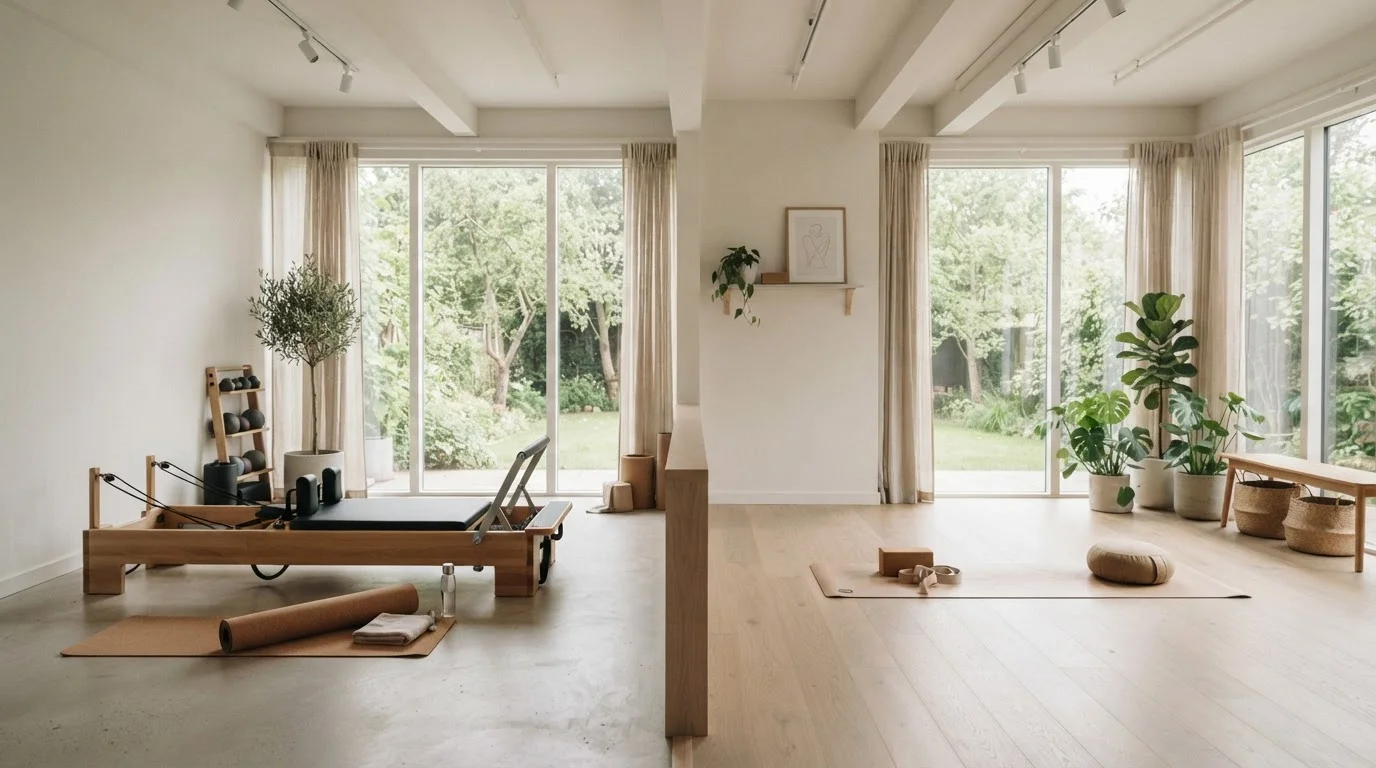
Pilates targets the deep stabilizing muscles of the core, including the transverse abdominis and multifidus, building what practitioners call a strong "powerhouse." Movements tend to be small, precise, and deliberately loaded. Equipment like the reformer adds spring resistance, making Pilates uniquely adaptable for both very deconditioned and highly athletic individuals.
Yoga works through a broader range of full-body postures, emphasizing eccentric lengthening of muscles, joint mobility, and balance. While some yoga styles — such as Ashtanga or Power Yoga — are genuinely demanding cardiovascular workouts, many prioritize flexibility and postural fluency over muscular load.
Breath, Mindfulness, and Mental Engagement
Both practices treat breath as a foundational tool, but they use it differently. In Pilates, breath is coordinated with movement to support spinal stability — for example, exhaling during exertion to engage the deep abdominals. The focus is biomechanical: breath serves the movement.
In yoga, breath work (pranayama) is a discipline in itself. Breathing patterns are used to regulate the nervous system, shift mental states, and deepen the connection between body and mind. Research published in peer-reviewed journals has associated regular yoga practice with measurable reductions in cortisol levels and improved self-reported stress.
Pilates can be deeply mindful, but the tradition does not carry the same meditative or philosophical framework that yoga does. Practitioners looking for a standalone mind-body practice in the broadest sense often find yoga's depth more expansive.
Combining Both Practices Safely
Many movement educators suggest treating Pilates and yoga as complementary rather than competing. Pilates can build the deep core stability that supports more advanced yoga postures, while yoga's flexibility work can reduce injury risk in Pilates exercises. If you are new to either practice, beginning with a supervised class gives you the feedback needed to progress safely and effectively.
This article is for general informational purposes only and is not medical advice. If you have a current injury, chronic condition, or are pregnant, consult a qualified healthcare professional before starting either practice.
Choosing the Practice That Fits Your Life
There is no objective winner between Pilates and yoga — the right choice depends on what you are trying to accomplish. If improving posture, rebuilding core stability, or recovering from a musculoskeletal issue is your priority, Pilates offers a targeted, evidence-supported pathway. If you want to increase full-body flexibility, manage stress, or explore a practice with broader philosophical dimensions, yoga provides a rich and scalable framework.
Importantly, the two are not mutually exclusive. Many fitness professionals and movement educators recommend combining both: using Pilates to build structural strength and stability, and yoga to maintain flexibility and mental restoration. Even two sessions of each per week can create a well-rounded movement routine for most healthy adults.
Start with beginner-level classes in both formats, ideally with a qualified instructor who can observe your alignment and offer corrections. What feels more intuitive to your body and more sustainable to your schedule is often the best guide of all.