
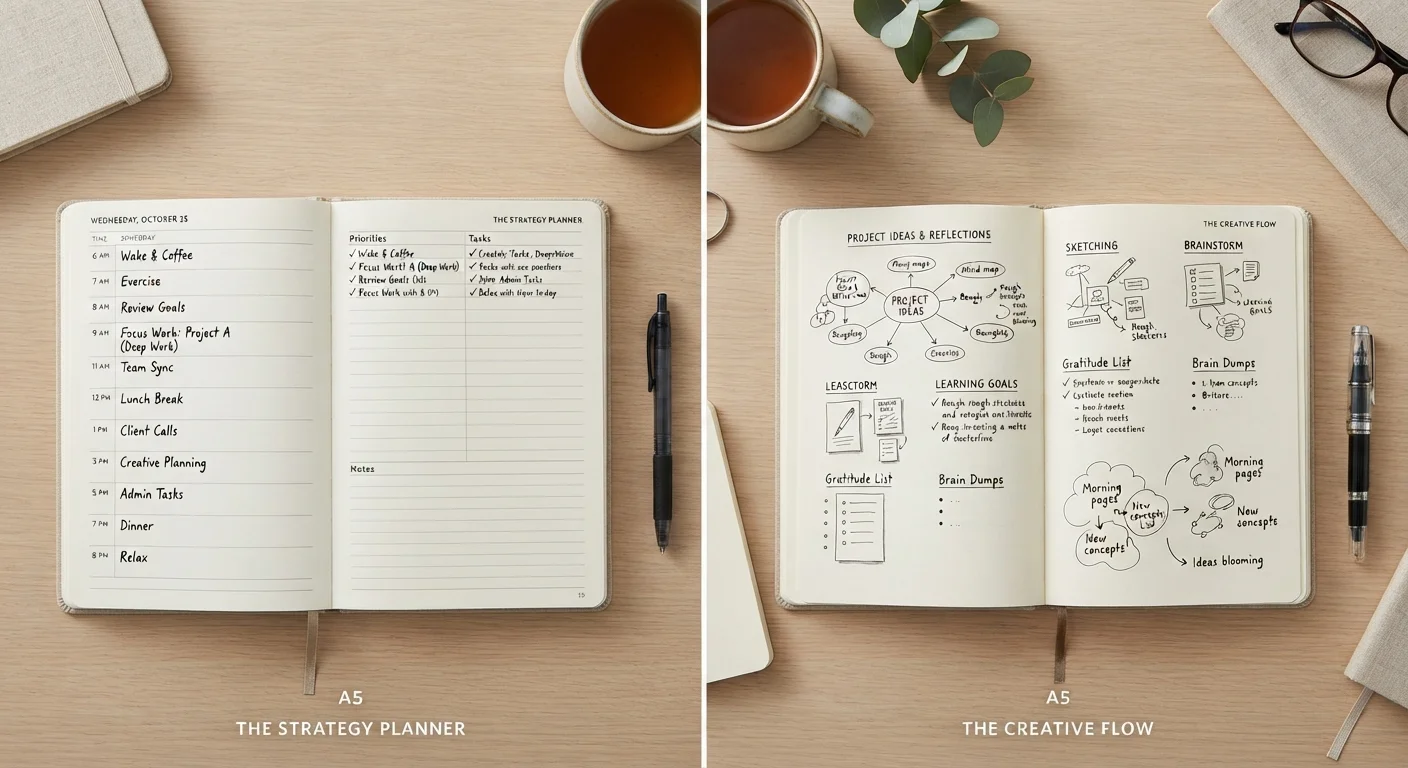
The Core Difference: Control vs. Adaptability
A rigid schedule assigns specific behaviors to fixed times — for example, a 6:30 a.m. workout, a noon lunch break, and a 10:00 p.m. lights-out. A flexible routine, by contrast, identifies which behaviors matter daily without locking them to a clock — exercising sometime in the morning, eating before early afternoon, winding down before sleep.
Both approaches aim to make healthy behavior more automatic. The difference lies in how much structure is imposed versus how much autonomy the individual retains. As explored in our guide to habit formation and daily routines, automaticity — the ability to perform a behavior with minimal conscious effort — is the ultimate goal of any routine-building strategy.
The question behavioral scientists ask is not which approach feels more disciplined, but which one actually sticks.
What Research Says About Rigid Scheduling
Fixed time-blocking has demonstrated measurable benefits in controlled settings. Studies on implementation intentions — the psychological technique of planning when, where, and how you will act — consistently show that specificity improves follow-through compared to vague intentions. Assigning a precise time to a behavior creates a mental cue that triggers action.
Rigid schedules also reduce decision fatigue. When daily structure is predetermined, cognitive load drops, leaving more mental energy for complex tasks. For people in stable, low-disruption environments, a detailed schedule can function almost like an external autopilot.
| Rigid Schedules | Flexible Routines | |
|---|---|---|
| Decision fatigue reduction | High — removes daily planning | Moderate — some choices remain |
| Resilience to disruption | Low — prone to collapse when broken | High — adapts to changing circumstances |
| Long-term adherence | Variable — works in stable environments | Generally stronger across diverse lifestyles |
| Autonomy and motivation | Lower — externally structured | Higher — self-directed pacing |
| Best for sleep consistency | Stronger — anchors circadian rhythm | Adequate if wake time is consistent |
| Ease of starting | Requires upfront planning effort | Lower barrier to entry |
The downside is brittleness. When a rigid schedule is disrupted — by illness, travel, or an unexpected obligation — research on self-regulation suggests people are more likely to abandon the entire routine rather than adapt it. This all-or-nothing response is one of the most cited reasons structured plans fail in real-world conditions. For a deeper look at these trade-offs, see our article on highly structured daily schedules.
The Case for Flexible Routines
Flexible routines preserve the behavioral anchors of a schedule — consistent sleep, movement, meals, and wind-down — without rigidly specifying the clock time. Research in behavioral science frames this as habit stacking around contextual cues (finishing breakfast, arriving home) rather than time cues alone.
This approach aligns more closely with how habits are neurologically encoded. According to habit loop theory, behaviors are triggered by cues, not calendars. Building routines around repeatable contextual triggers — rather than fixed times — makes them more portable and resilient across varying days.
Flexible routines also support psychological autonomy, which motivation research consistently links to long-term adherence. When people feel in control of when and how they perform a behavior, compliance tends to be higher and drop-off lower. Daily routines and long-term health are most durably linked when the routine feels self-chosen rather than externally imposed.
Building a Hybrid Approach That Lasts
For most people, the evidence points toward a middle path: anchor a small number of non-negotiable daily behaviors to reliable cues, while leaving the timing flexible enough to accommodate real life. This might look like always exercising before your first work meeting, or always dimming lights after dinner — behaviors tethered to sequence rather than a specific hour.
Sleep consistency is one area where some time-anchoring does matter. Research consistently shows that irregular sleep-wake timing disrupts circadian rhythm and reduces sleep quality. Our comparison of fixed bedtime vs. flexible sleep schedules examines this trade-off in depth.
A practical starting point is to identify two or three keystone habits — behaviors that, when done consistently, tend to reinforce other healthy choices — and protect them without over-engineering the surrounding schedule. Keeping the routine simple and repeatable matters more than keeping it precise.
This article is for informational purposes only and is not a substitute for personalized medical or psychological advice. Consult a qualified healthcare professional for guidance specific to your health situation.