
Why Mindset Matters More Than Method
Decades of behavioral research suggest that what people think about their weight management efforts often predicts outcomes more reliably than the specific dietary approach they choose. Cognitive patterns — recurring ways of interpreting events, setbacks, and progress — can quietly erode even well-designed strategies.
This article focuses on the thinking errors most likely to undermine long-term success, why they're so common, and what evidence-informed alternatives look like in practice. This is general health information, not medical advice. Always consult a qualified healthcare professional for guidance tailored to your individual circumstances.
The Most Undermining Thinking Patterns
The cognitive mistakes below are drawn from behavioral and health psychology research. Recognizing them is the first step toward correcting course — not with harsh self-judgment, but with practical adjustment.
All-or-nothing thinking: treating any deviation from a plan as total failure.
Why it happens: Binary framing is cognitively efficient — it's simpler to classify days as 'good' or 'bad' than to hold nuance. Diet culture also reinforces this by emphasizing rigid rules.
Short-term framing: expecting rapid, linear results and losing motivation when they don't appear.
Why it happens: Marketing around weight loss promotes dramatic timelines. The human brain is also wired to discount distant rewards, making slow, compounding progress feel inadequate.
Catastrophizing setbacks: treating a difficult week as permanent evidence of inability to change.
Why it happens: Setbacks activate threat responses in the brain, and without a counternarrative, negative self-talk fills the gap. People with a history of repeated 'failed' attempts are especially vulnerable to this pattern.
Relying on motivation as the primary driver of behavior change.
Why it happens: Motivation feels powerful at the start of any new effort, so people attribute their early success to it — and then assume its absence explains later struggles.
Outcome-only focus: measuring success exclusively through weight, ignoring other meaningful markers.
Why it happens: Weight is visible and quantifiable, making it the default metric. Other improvements — sleep quality, energy, blood pressure, mood — are harder to track and easier to overlook.
Understanding why these habits collapse can also help. Research on why healthy eating habits collapse by week three points to many of the same cognitive traps described here — particularly the perfectionism spiral and the expectation of linear results.
Building a More Sustainable Mental Framework
~80%
Weight regain rate within five years
Research published in the American Journal of Clinical Nutrition estimates that a large majority of people who lose weight regain it within five years, with psychological factors identified as significant contributors.
2x
Greater long-term adherence with flexible vs. rigid dietary restraint
Studies in eating behavior research have found that flexible dietary restraint is associated with significantly better long-term adherence compared to rigid, rule-based approaches.
Reframing how you think about weight management doesn't mean lowering your standards — it means adopting standards that are actually achievable over time. Rather than tracking every calorie as a proxy for control, many people find that building eating habits that support a healthy weight without constant tracking reduces cognitive burden while improving consistency.
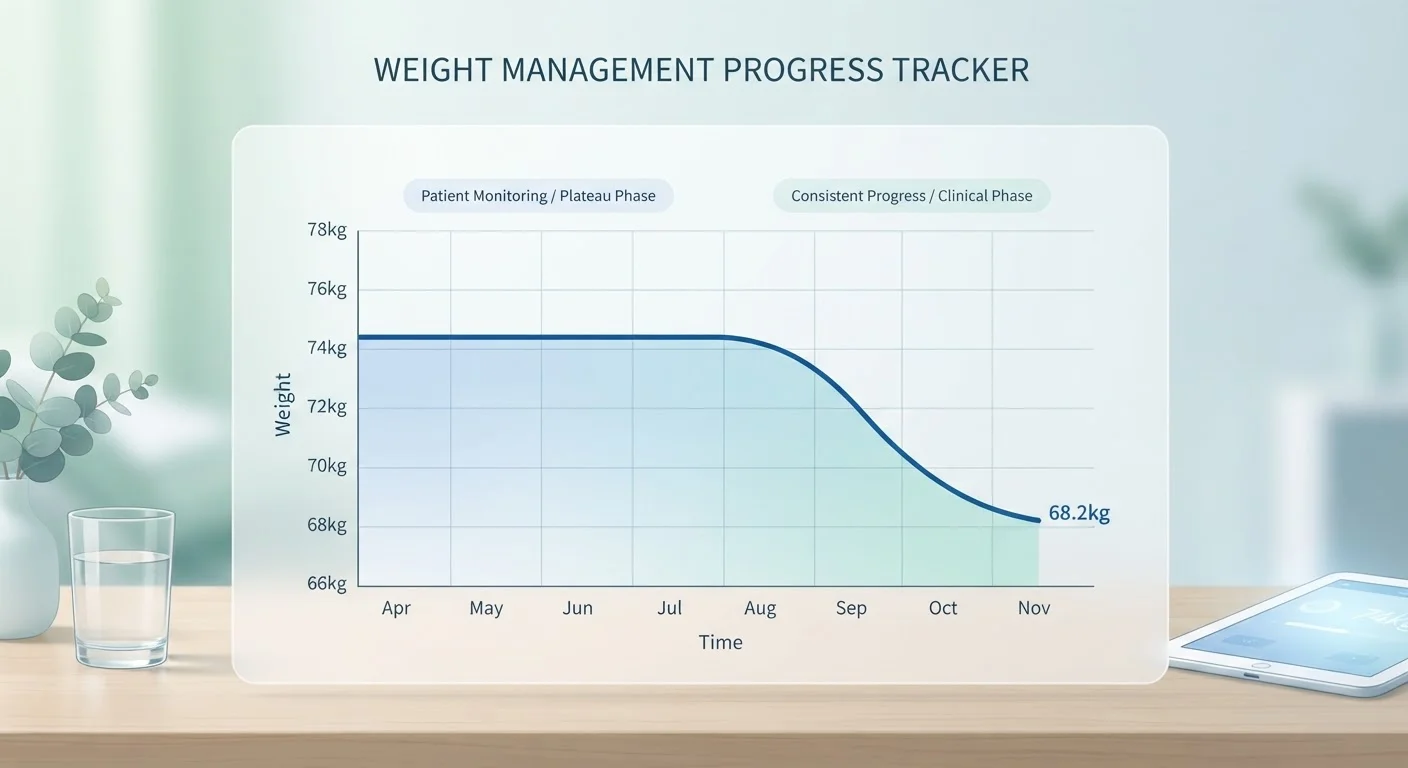
When weight loss stalls — as it predictably does for physiological reasons — the temptation is to interpret a plateau as failure. Understanding what's actually happening metabolically can prevent that misreading. Our article on understanding weight plateaus explains why stalls are a normal part of the process, not evidence that your approach isn't working.
Emotional regulation also plays a central role. Patterns that feel neutral — like using food for stress relief — can gradually undermine both emotional stability and weight management goals. Reviewing habits that quietly undermine emotional balance can surface connections you might not have noticed.
This article is for informational purposes only and is not a substitute for professional medical advice, diagnosis, or treatment. Consult a qualified healthcare provider before making significant changes to your diet, exercise routine, or health behaviors.