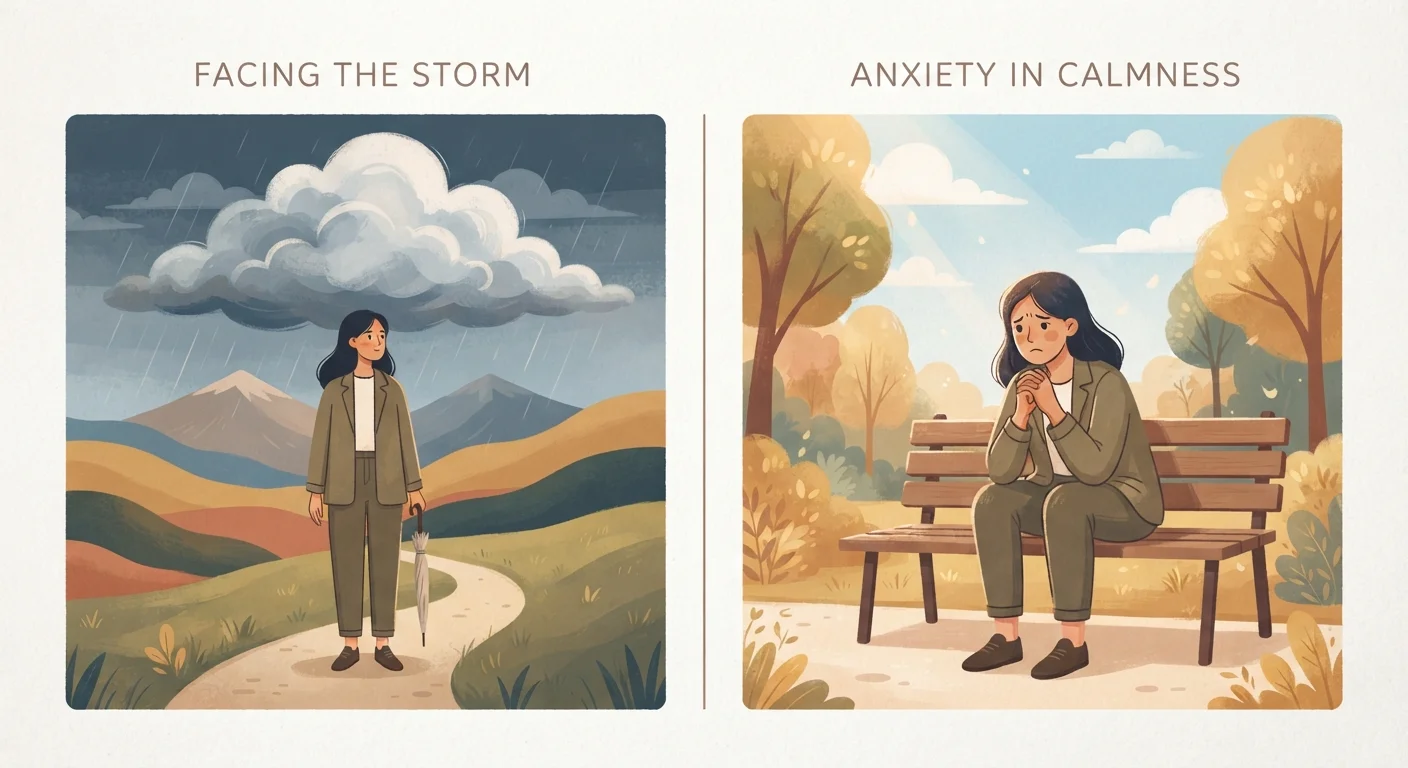

The Relief That Makes Things Worse
It makes perfect sense to step away from something that frightens you. In the short run, avoidance delivers exactly what it promises: anxiety drops, breathing slows, and the moment feels manageable again. But behavioral science tells a more complicated story about what happens next.
When you avoid a feared situation, your brain's threat-detection system — centered in an area called the amygdala — receives an unintended message: we were right to be afraid of that. The anxiety was not tested; it was confirmed. The next time a similar situation arises, the alarm sounds a little louder, and the pull to escape feels a little stronger. This self-reinforcing loop is one of the core mechanisms behind how anxiety disorders develop and persist.
Understanding how anxiety differs from everyday stress can help clarify why avoidance is particularly problematic for anxiety specifically — and why the same strategy may have different consequences depending on what you're actually experiencing.
Common Avoidance Mistakes and How to Break the Cycle
Most people don't recognize their avoidance patterns because avoidance is rarely dramatic. It shows up in small, reasonable-looking decisions made dozens of times a day. The mistakes below represent the most common ways avoidance quietly gains ground — and what behavioral research suggests instead.
Treating avoidance as a long-term coping strategy rather than a temporary reflex.
Why it happens: Avoidance works immediately — anxiety drops the moment you step back from a feared situation. That fast relief feels like evidence the strategy is helpful, making it easy to repeat.
Confusing subtle avoidance behaviors with healthy self-care or practical choices.
Why it happens: Avoidance rarely announces itself. Canceling plans 'because you're tired,' over-preparing to the point of paralysis, or always asking others to handle anxiety-provoking tasks can all be forms of avoidance dressed up as reasonable decisions.
Seeking constant reassurance as a way to avoid sitting with uncertainty.
Why it happens: Reassurance feels like information-gathering, but when it becomes compulsive — repeatedly asking others if everything will be okay — it is a form of avoidance that prevents the brain from learning to tolerate uncertainty on its own.
Attempting to eliminate anxiety entirely rather than learning to function alongside it.
Why it happens: Many people assume the goal of anxiety management is to feel no anxiety at all. This belief leads to more avoidance, because any hint of anxious feelings triggers another round of escape behaviors.
Avoiding professional support because seeking help feels frightening or stigmatized.
Why it happens: For many people, asking for help about anxiety triggers its own anxiety — fear of judgment, of being seen as 'broken,' or simply of confronting the problem directly.
It is also worth noting that avoidance and 'pushing through' without support are not the only two options. Forcing yourself through stress without a strategy can be just as counterproductive as retreating from it entirely.
What Approaching Anxiety Actually Looks Like
Avoidance Can Quietly Shrink Your World
When avoidance becomes habitual, it tends to expand — what started as skipping one stressful meeting can grow into withdrawing from work, social life, or activities you once valued. This progressive narrowing is a recognized warning sign that anxiety may be intensifying. If avoidance is significantly limiting your daily functioning, consulting a licensed mental health professional is an important next step.
The evidence-based alternative to avoidance is graduated exposure — deliberately and incrementally approaching feared situations in a controlled, supported way. This is the backbone of Cognitive Behavioral Therapy for anxiety, and decades of research support its effectiveness. The idea is not to flood yourself with fear all at once, but to take manageable steps that give the brain new evidence: this situation is uncomfortable, but I can handle it.
Building broader resilience habits alongside this work matters too. Evidence-based practices for long-term stress resilience can reinforce the nervous system's capacity to tolerate discomfort over time. Social support also plays a meaningful role — research consistently links strong relationships to lower anxiety and better coping.
If you recognize several of the patterns described in this article, you are not alone, and you are not failing. Avoidance is a universal human instinct. Awareness of it is the starting point — and for many people, working with a licensed mental health professional is the most effective way to begin moving in a different direction.
This article is for general informational and educational purposes only and does not constitute medical or mental health advice. If you are struggling with anxiety that interferes with daily life, please consult a qualified healthcare or mental health professional.