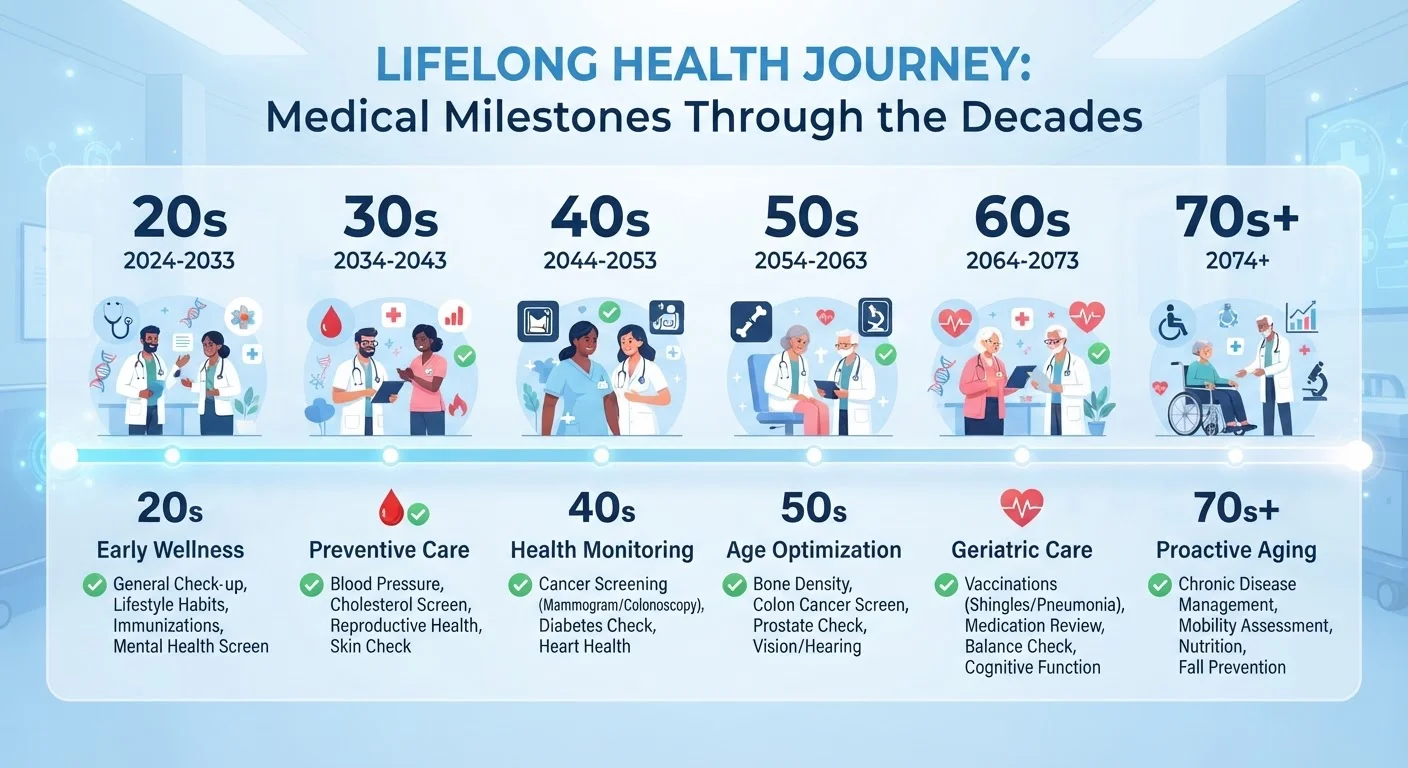

The Core Idea: Testing Before There's a Problem
Most people associate medical tests with feeling unwell. You develop chest pain, you see a doctor, and they run tests to find out why. Preventive screenings flip that model entirely. They are performed before any symptom appears, on the premise that catching a condition early — or identifying a risk factor before it becomes a condition — produces far better outcomes than waiting for trouble to announce itself.
This distinction matters practically. If you visit your doctor for a routine blood pressure check and your numbers are elevated, that is a screening finding. If you arrive with severe headaches and your doctor checks your blood pressure to investigate the cause, that is diagnostic. The measurement may look identical, but the clinical purpose and insurance classification are different. See our guide to annual physicals vs. preventive wellness visits for a deeper look at how these appointment types are structured.
What Makes a Screening Test Worth Recommending
Not every conceivable test qualifies as a recommended preventive screening. Public health bodies such as the USPSTF evaluate screenings against a rigorous set of criteria before endorsing them for general use:
- The condition must be significant. It causes meaningful harm if undetected and untreated.
- Early detection must change outcomes. Finding it sooner must actually improve survival or quality of life compared to finding it later.
- The test must be accurate and practical. It needs an acceptable rate of true positives and false positives and must be feasible for use in a broad population.
- The benefits must outweigh the harms. All screening carries some risk — anxiety, false positives, follow-up procedures. The net benefit must be positive.
This framework is why some intuitively appealing tests — like full-body CT scans for everyone — are not broadly recommended: the harms from radiation exposure and false-positive follow-ups outweigh the benefits for average-risk individuals.
45
Age to start colorectal cancer screening (average risk)
The American Cancer Society and USPSTF recommend colorectal cancer screening beginning at age 45 for average-risk adults.
80%
Of colorectal cancers could potentially be prevented or caught early
The American Cancer Society estimates that most colorectal cancers are preventable or highly treatable when detected through regular screening.
1 in 3
U.S. adults with undiagnosed hypertension
The CDC estimates that approximately one in three American adults has high blood pressure, and many are unaware because symptoms are often absent.
Common Types of Preventive Screenings
Preventive screenings span a wide range of conditions and formats. Some are simple measurements taken during a routine visit; others are more involved procedures. Common categories include:
- Cardiovascular risk screenings
- Blood pressure measurement, cholesterol panels (lipid profiles), and blood glucose tests for diabetes risk are among the most frequently performed. These can be done during a standard office visit.
- Cancer screenings
- Mammograms for breast cancer, colonoscopies or stool-based tests for colorectal cancer, Pap smears and HPV tests for cervical cancer, and low-dose CT scans for lung cancer in high-risk individuals are all evidence-supported examples.
- Infectious disease screenings
- HIV testing, hepatitis C screening, and sexually transmitted infection tests are recommended on a schedule based on age, risk factors, and exposure history.
- Mental health and behavioral screenings
- Depression screening using validated questionnaires is recommended by the USPSTF for adults, including pregnant and postpartum individuals.
For a structured, age-by-age reference, see your preventive health screening timeline, decade by decade.
Why Healthy People Benefit Most
The counterintuitive truth about preventive screenings is that healthy people stand to gain the most from them. When a condition is caught at an early, asymptomatic stage, the range of effective interventions is typically broader, less invasive, and more likely to be curative. A colorectal polyp removed during a colonoscopy before it becomes cancer requires no chemotherapy. Hypertension identified and managed early may prevent a stroke years down the road.
Waiting until symptoms appear often means the disease has already progressed. At that point, treatment becomes more complex, more costly, and less certain in outcome. This is not meant to alarm — it is simply the biological reality of how many chronic diseases develop silently over time.
If you have encountered arguments against screening — such as concerns about overdiagnosis or unnecessary procedures — those are legitimate topics worth understanding. Our article on the benefits and limitations of preventive screenings covers both sides of that conversation honestly. And if you have heard common objections like "I feel fine, so I don't need it," the evidence-based responses in screening myths that keep people from getting checked are worth reading.
This article is for general informational purposes only and does not constitute medical advice. Always consult a qualified healthcare provider to determine which screenings are appropriate for your individual health situation.