
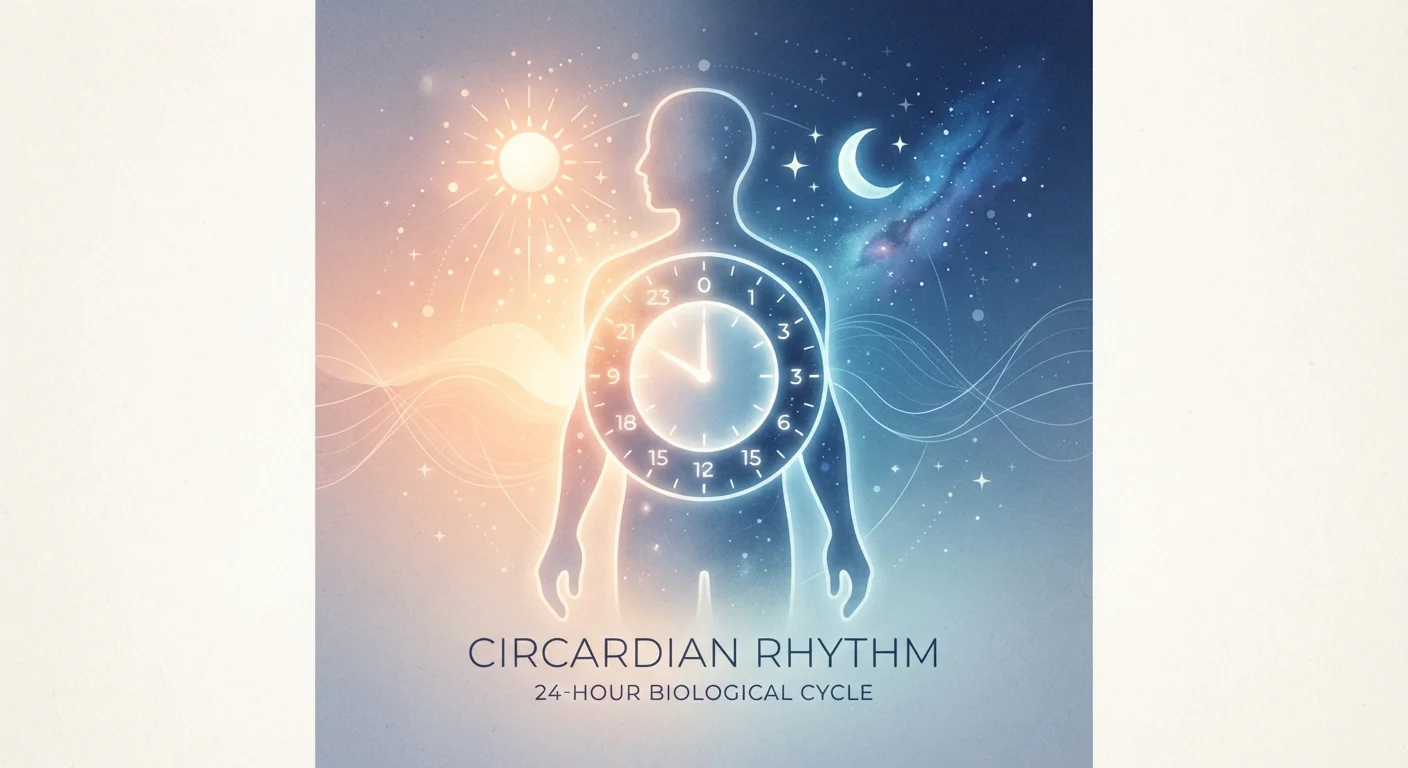
What Is a Circadian Rhythm?
The word circadian comes from the Latin circa dies — meaning "about a day." Your circadian rhythm is a roughly 24-hour biological cycle that operates inside almost every cell of your body, quietly orchestrating when you feel alert, hungry, energized, or ready for sleep.
These rhythms aren't just about tiredness. They influence body temperature, hormone secretion, immune function, digestion, and even how well your heart performs at different times of day. For a broader look at how these cycles connect to your daily habits, see our complete daily health routine guide.
Circadian rhythm
A roughly 24-hour internal biological cycle that regulates many body functions, including sleep, hormone release, and metabolism.
Suprachiasmatic nucleus (SCN)
A small region in the brain's hypothalamus that acts as the body's master clock, coordinating timing signals to organs and tissues throughout the body.
Melatonin
A hormone produced by the pineal gland that signals nighttime to the body, promoting drowsiness and helping align sleep timing with darkness.
Zeitgeber
German for 'time giver' — any external cue, such as light, temperature, or meal timing, that helps synchronize the body's internal clock to the environment.
Chronotype
An individual's natural tendency toward earlier or later sleep-wake timing, commonly described as being a 'morning person' or 'evening person.'
Circadian misalignment
A state where the body's internal clock is out of sync with the external environment or behavioral schedule, often caused by shift work, jet lag, or irregular routines.
How Your Internal Clock Actually Works
The body's master timekeeper is a cluster of roughly 20,000 nerve cells in the brain called the suprachiasmatic nucleus, or SCN. Located in the hypothalamus — directly above where the optic nerves cross — the SCN receives light signals from the eyes and uses them to keep the body's timing synchronized with the external world.
When light hits specialized photoreceptor cells in the retina, a signal travels to the SCN. In daylight, the SCN suppresses melatonin production and promotes wakefulness. As darkness falls, the SCN signals the pineal gland to release melatonin, which prepares the body for sleep. This light-dark cycle is the body clock's primary zeitgeber — its most powerful environmental reset signal.
Peripheral clocks in the liver, heart, gut, and other organs also run on roughly 24-hour cycles. These local clocks are coordinated by the SCN but can drift if secondary cues — like meal timing or exercise — consistently pull in a different direction.
What Your Body Clock Controls Beyond Sleep
Most people think of circadian rhythms mainly in terms of sleep, but the clock's reach extends much further:
- Core body temperature peaks in the late afternoon and dips in the early morning hours — the lowest point typically coincides with deep sleep.
- Cortisol, the body's primary alerting hormone, surges shortly after waking to help mobilize energy and sharpen focus.
- Digestive enzymes and gut motility follow circadian patterns, which is why eating at unusual hours can cause discomfort or affect how nutrients are processed.
- Immune function has documented circadian variation, with certain immune responses more active at night.
- Cardiovascular stress — including the risk window for heart attacks — shows a well-documented morning peak linked to early-morning surges in blood pressure and clotting activity.
Understanding this scope is part of why the full picture on sleep reaches well beyond bedtime habits.
What Disrupts Your Circadian Rhythm
Modern life presents multiple challenges to a stable body clock:
- Artificial light at night — especially short-wavelength blue light from screens — suppresses melatonin and delays the sleep signal.
- Irregular sleep schedules confuse the SCN by shifting the timing of light exposure and behavioral cues from day to day.
- Shift work forces the body to be awake when the clock expects sleep, creating sustained circadian misalignment that research associates with elevated cardiometabolic and mental health risks.
- Jet lag is a temporary but acute form of misalignment, as the internal clock takes time to catch up with a new time zone.
- Late eating can decouple peripheral clocks in the gut and liver from the central SCN signal.
Chronic Disruption Warrants Professional Attention
If you consistently struggle with sleep timing, alertness, or mood despite maintaining regular routines, this may point to a circadian rhythm sleep-wake disorder or another underlying condition. These are distinct from ordinary tiredness and are best evaluated by a qualified healthcare provider or sleep specialist — not managed with self-help strategies alone.
Chronotype also matters: individuals differ genetically in their natural timing. Forcing an evening-type person onto an early-morning schedule creates what researchers call "social jetlag" — a chronic mismatch between biological and social time.
Working With Your Clock, Not Against It
You don't need to overhaul your life to support your circadian rhythm. A handful of consistent habits can make a meaningful difference:
Anchor Your Clock With Morning Light
Getting bright natural light within an hour of waking is one of the most effective ways to reinforce your circadian rhythm. Even on cloudy days, outdoor light is significantly brighter than typical indoor lighting. A short morning walk can serve double duty — light exposure for your clock plus gentle movement.
- Keep a consistent sleep and wake time, including on weekends, to give your SCN a stable anchor.
- Limit bright and blue light in the evening — dim your home lighting and lower screen brightness in the hour or two before bed.
- Eat meals at regular times aligned with daylight hours when possible, as meal timing reinforces peripheral clock signals.
- Time exercise thoughtfully — morning or afternoon physical activity tends to support circadian stability better than very late-night workouts for most people, though individual responses vary.
For a science-backed look at why consistent daily routines matter at a biological level, see the science behind daily routines. And for practical evening and sleep habit frameworks, the Better Sleep Habits hub is a useful next stop.
This article is for general informational and educational purposes only and does not constitute medical advice. If you have concerns about your sleep patterns, energy levels, or overall health, please consult a qualified healthcare professional.