Three Terms, Three Different Things
BMR, RMR, and TDEE appear constantly in nutrition and fitness discussions — often as if they mean the same thing. They don't. Each term describes a distinct measurement of how the body uses energy, and conflating them can lead to miscalculations and misplaced expectations.
If you've ever used an online calculator to estimate your calorie needs, you've likely encountered at least one of these terms without a clear explanation of what's actually being measured. This reference breaks each one down precisely. For a broader foundation, see what metabolism actually is before diving in.
| BMR share of daily calorie burn | 60–75% (sedentary adults) (Estimated range cited across metabolic physiology literature) |
| RMR vs. BMR difference | RMR typically 10–20% higher (Due to less restrictive measurement conditions) |
| Prediction equation accuracy | Within ~10–15% for most adults (Mifflin-St Jeor and Harris-Benedict equations) |
| Thermic effect of food (TEF) | ~10% of TDEE (General clinical estimate; varies by macronutrient composition) |
| TDEE components | 4 (RMR, TEF, exercise, NEAT) |
BMR: The Absolute Baseline
Basal Metabolic Rate (BMR) is the minimum number of calories your body requires to sustain essential life functions — breathing, circulation, cell production, and temperature regulation — under strictly controlled conditions. These conditions include being fully at rest, in a thermoneutral environment, and in a post-absorptive state (typically 12 or more hours after eating).
Because true BMR measurement requires a clinical lab setting, most people never actually measure their BMR directly. Instead, they use validated prediction equations — such as the Mifflin-St Jeor or Harris-Benedict formulas — which estimate BMR from height, weight, age, and sex. These equations carry a margin of error, typically within 10–15% for most adults under normal conditions.
BMR accounts for roughly 60–75% of total daily energy expenditure in sedentary individuals, making it the single largest contributor to how many calories your body burns each day.
RMR: The Practical Stand-In
Resting Metabolic Rate (RMR) — sometimes called Resting Energy Expenditure (REE) — measures energy use while at rest, but without the rigorous fasting and environmental controls required for BMR. As a result, RMR is easier to measure in clinical and research settings and is the value most metabolic testing devices and indirect calorimetry assessments actually report.
RMR values are typically 10–20% higher than true BMR, primarily because the post-meal digestive state and minor muscle activity slightly elevate energy use compared to strict basal conditions. In practice, the two terms are used interchangeably in most consumer contexts — but it's worth knowing that when a fitness tracker or dietitian quotes your "resting" calorie burn, they're almost certainly referring to RMR, not true BMR.
Basal Metabolic Rate (BMR)
The minimum calories needed to sustain essential body functions at complete rest, measured under strict clinical conditions including fasting and a controlled environment.
Resting Metabolic Rate (RMR)
The calories burned at rest under less restrictive conditions than BMR testing. RMR is the value most metabolic assessments and prediction tools report, and it runs slightly higher than true BMR.
Total Daily Energy Expenditure (TDEE)
The total calories your body burns in a day, combining resting metabolism, digestion, intentional exercise, and all other physical movement.
Thermic Effect of Food (TEF)
The energy your body expends digesting, absorbing, and metabolizing the food you eat. TEF typically accounts for roughly 10% of total daily energy expenditure.
Non-Exercise Activity Thermogenesis (NEAT)
Calories burned through all movement that isn't structured exercise — including walking, fidgeting, standing, and daily household tasks. NEAT varies widely between individuals and significantly influences TDEE.
Indirect Calorimetry
A clinical method for measuring metabolic rate by analyzing the oxygen consumed and carbon dioxide produced during breathing, considered the most practical gold standard for RMR assessment outside laboratory settings.
TDEE: What You Actually Burn Each Day
Total Daily Energy Expenditure (TDEE) is the total number of calories your body burns over a full day, accounting for all activity. It's calculated by multiplying your RMR (or estimated BMR) by an activity factor that reflects how physically active you are.
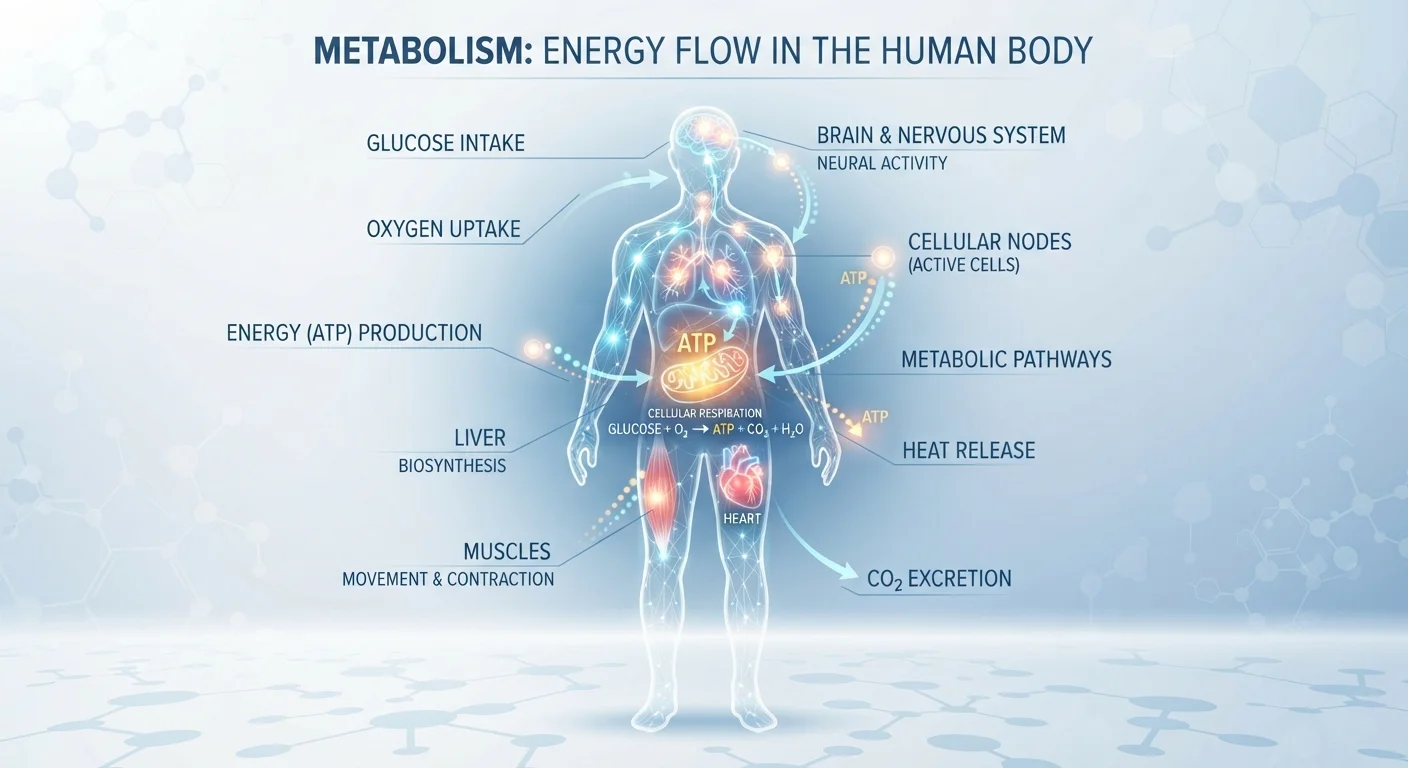
TDEE has four components: resting energy expenditure (RMR/BMR), the thermic effect of food (the energy cost of digesting meals), exercise activity thermogenesis (intentional workouts), and non-exercise activity thermogenesis or NEAT (all movement that isn't formal exercise — walking, fidgeting, household tasks). Each of these components contributes meaningfully to your daily total.
TDEE is the number most relevant to weight management decisions. Consuming fewer calories than your TDEE creates a deficit; consuming more creates a surplus. However, as explored in our companion article on calorie deficit vs. metabolic health, the arithmetic alone doesn't capture the full picture of how bodies respond to energy balance over time.
This article is for informational purposes only and is not a substitute for personalized medical or nutritional advice. Consult a qualified healthcare professional for guidance specific to your health situation.