Why Energy Expenditure Is More Than Just Exercise
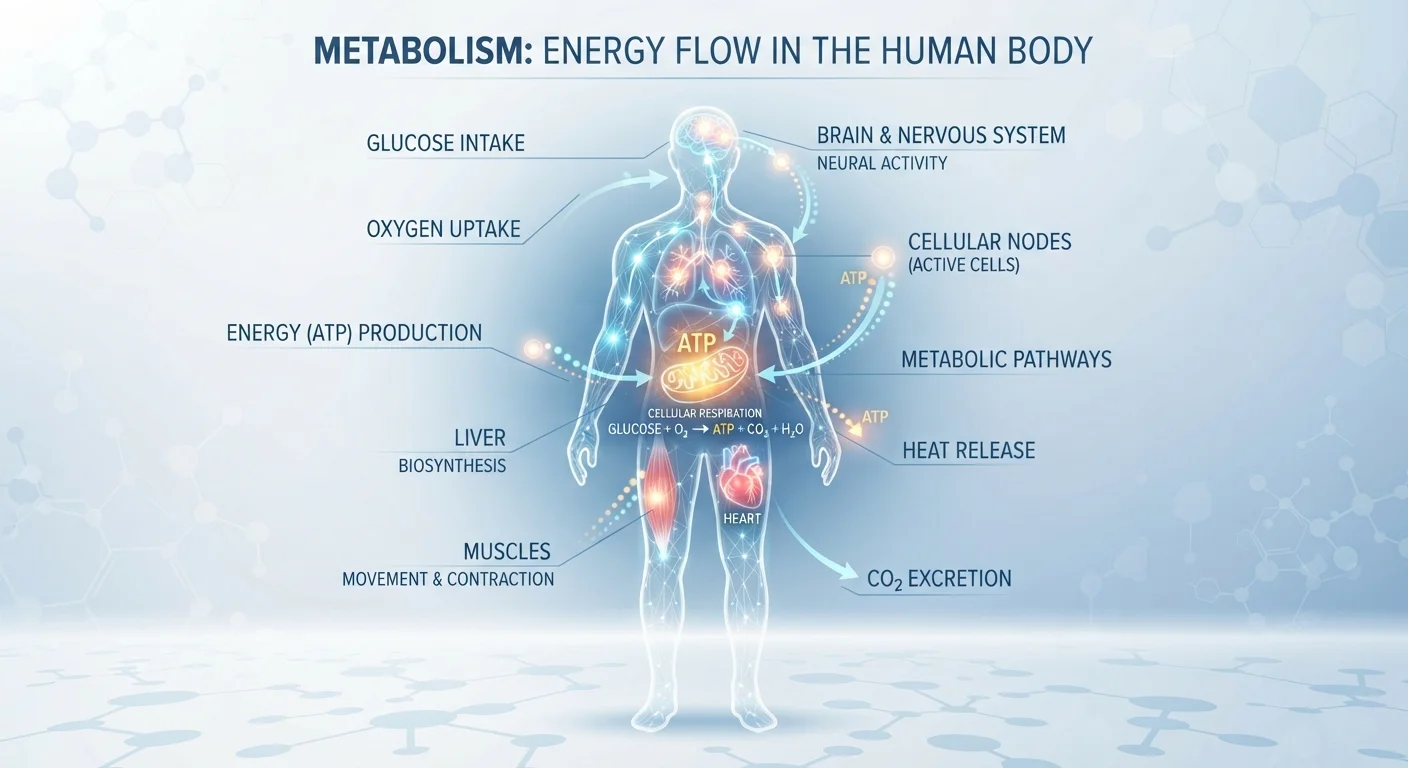
Most discussions of calorie burn center on workouts: how many calories did you burn on the treadmill? But structured exercise typically accounts for only a small fraction of the total energy your body uses each day. The reality is that your body is burning calories constantly — through processes most people never think about.
Total daily energy expenditure is the sum of four physiologically distinct components. Each one operates through different mechanisms, responds differently to lifestyle choices, and contributes a different share to your overall calorie burn. Grasping all four is essential for understanding why energy balance is far more nuanced than a simple "calories in, calories out" equation. For a broader look at how TDEE relates to other metabolic terms, see our plain-language breakdown of BMR, RMR, and TDEE.
Component 1: Basal Metabolic Rate (BMR)
Basal metabolic rate represents the energy your body requires to sustain core physiological functions — breathing, circulation, cell repair, temperature regulation, and organ function — while at complete rest and in a post-absorptive state. For most adults, BMR accounts for approximately 60–70% of TDEE, making it by far the dominant component.
BMR is influenced by factors including lean muscle mass, age, sex, genetics, thyroid function, and body surface area. Muscle tissue is metabolically more active than fat tissue, which is why individuals with greater muscle mass generally have higher BMRs. BMR is not fixed — it decreases with age and declines in response to sustained calorie restriction, a physiological adaptation that can complicate long-term weight management.
60–70%
Share of TDEE from basal metabolic rate
Research consistently shows BMR is the dominant energy expenditure component for most sedentary to moderately active adults.
~10%
TDEE contribution from thermic effect of food
TEF represents a reliable but modest fraction of daily calorie burn, varying by macronutrient composition.
Up to 1,000 kcal
Daily calorie range for NEAT in active individuals
Studies on NEAT variability show that highly active non-exercising individuals can burn dramatically more than sedentary counterparts through incidental movement alone.
Component 2: The Thermic Effect of Food (TEF)
Digesting, absorbing, and metabolizing the food you eat costs energy. This cost is known as the thermic effect of food (TEF) and typically accounts for roughly 10% of TDEE. Crucially, TEF is not uniform across all foods — it varies considerably by macronutrient.
Protein has the highest thermic effect, requiring an estimated 20–30% of its own caloric value for processing. Carbohydrates carry a TEF of approximately 5–10%, while dietary fat is the most efficiently metabolized macronutrient, with a TEF of only around 0–3%. This means the composition of your diet — not just its caloric total — has a measurable effect on how much energy your body expends. For a deeper look at how macronutrients drive this process, explore our article on the thermic effect of food and macronutrient differences.
Component 3: Exercise Activity Thermogenesis (EAT)
Exercise activity thermogenesis is the energy expended during deliberate, structured physical activity — running, resistance training, cycling, swimming, and so on. While this is the component most people focus on, it typically contributes only 5–15% of TDEE for most non-athletes.
EAT varies enormously between individuals based on exercise frequency, intensity, duration, and body weight. A 150-pound person running at a moderate pace burns substantially fewer calories per session than a 220-pound person performing the same workout. The body also adapts to repeated exercise stimuli over time, which is why calorie expenditure for a given activity can decrease as fitness improves and movement becomes more efficient.
Component 4: Non-Exercise Activity Thermogenesis (NEAT)
Non-exercise activity thermogenesis captures all the energy burned through movement that isn't structured exercise: walking to the mailbox, fidgeting, gesturing while talking, doing household chores, or standing at a desk. NEAT is the most variable component of TDEE — it can range from as few as 200 additional calories per day in sedentary individuals to over 1,000 calories per day in highly active ones.
Research suggests that NEAT is significantly influenced by both conscious choices and involuntary physiological responses. During periods of caloric surplus or deficit, the body can unconsciously up- or downregulate NEAT — a phenomenon that helps explain why some people seem to resist weight change more than others. Understanding NEAT reframes the conversation: daily movement habits that seem trivial in isolation collectively have a substantial metabolic impact. This connects directly to why the math of a calorie deficit alone doesn't tell the whole story.
How the Four Components Interact
TDEE is not a static figure — it is a dynamic outcome of interacting biological systems. When one component shifts, others can compensate. Sustained caloric restriction, for example, typically reduces BMR and may suppress NEAT simultaneously, blunting the expected energy deficit. Conversely, building lean muscle mass through resistance training can gradually raise BMR over time.
The macronutrient composition of your diet affects TEF; your lifestyle architecture — how much you sit versus move throughout the day — determines NEAT; and your training program governs EAT. Understanding how macronutrients move from digestion to daily energy adds further context to how food choices ripple through your total expenditure. Metabolism, in other words, is not a simple furnace — it is a responsive, adaptive system best managed with nuance rather than arithmetic alone.
This article is for general informational and educational purposes only and does not constitute medical or nutritional advice. Consult a qualified healthcare professional before making changes to your diet, exercise routine, or health plan.