
Why the Hour Before Bed Is So Consequential
Sleep doesn't switch on like a light. It's a gradual biological process that requires your body and brain to downshift through a series of physiological changes — falling core temperature, rising melatonin, slowing heart rate, and quieting of the stress-response system. The behaviors you engage in during the final hour of your day either accelerate or obstruct that transition.
The problem is that modern evenings are filled with inputs that work against this process: bright overhead lighting, emotionally stimulating content, late work emails, and the low-level hum of unresolved mental tasks. Your nervous system can't easily tell the difference between a real threat and a stressful Slack notification, so it stays in a mild state of alert — making sleep onset slower and lighter sleep more likely.
A deliberate wind-down routine works by sending consistent, reliable signals that the demands of the day are over. Over time, this sequence becomes a conditioned cue your brain recognizes and responds to automatically. For a deeper look at habits that quietly work against this process, see nighttime habits that quietly undermine your sleep. And for a broader evidence base on sleep and recovery strategies, the Sleep & Recovery hub is a useful starting point.
This Is General Education, Not Medical Advice
The guidance in this article is intended for general informational purposes and does not substitute for advice from a qualified healthcare provider. If you experience persistent insomnia, sleep disturbances, or related health concerns, please consult a physician or sleep specialist.
Your Step-by-Step Evening Wind-Down
The steps below are designed to work as a sequence. Each one builds on the last, progressively reducing physiological and psychological arousal so that by the time your head reaches the pillow, your body is already primed for sleep.
What you will need
Set a consistent start time for your wind-down
Choose a fixed time — typically 45 to 60 minutes before your target bedtime — and treat it as a non-negotiable daily transition. Your brain learns to anticipate sleep through repetition, so a consistent start time is the foundation everything else builds on.
Dim the lights throughout your home
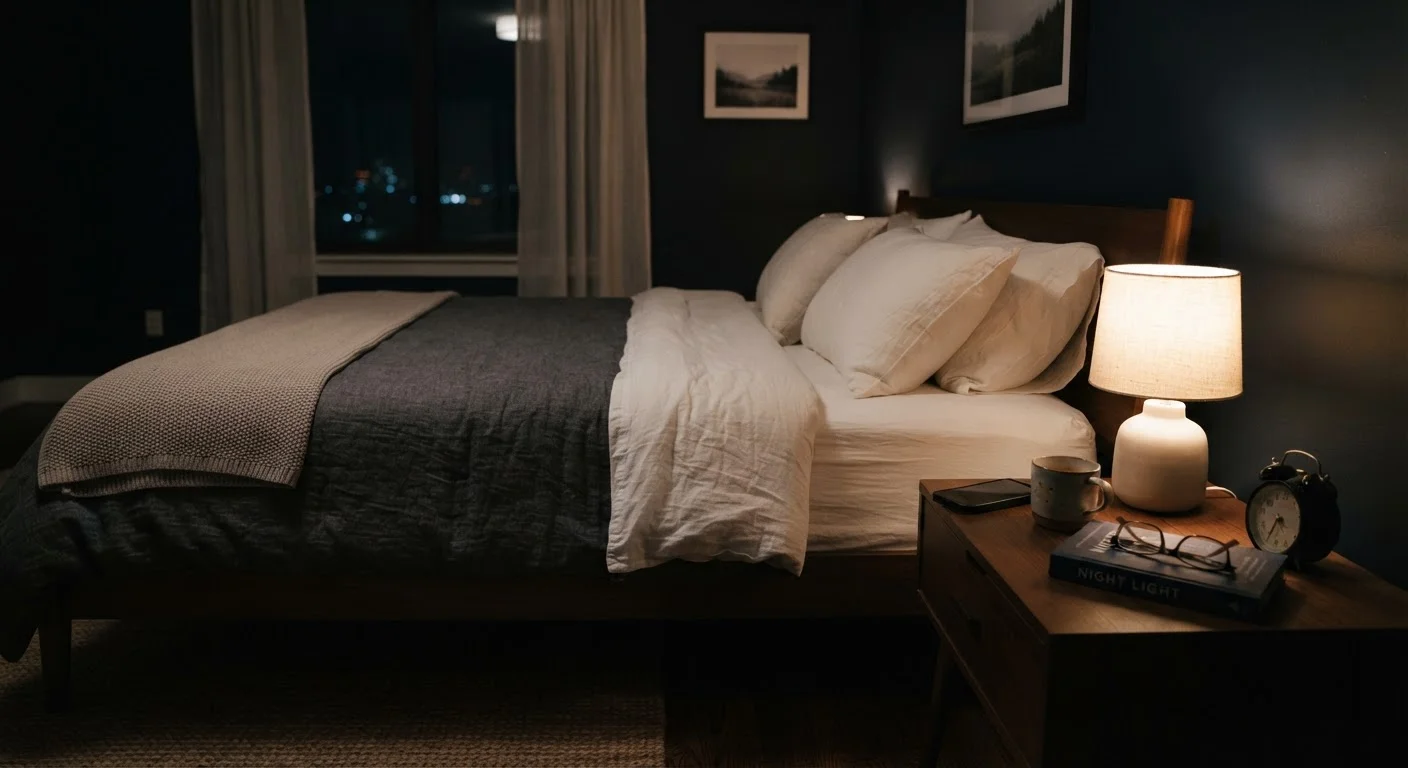
Light is the most powerful external regulator of your circadian rhythm. In the hour before bed, switch off overhead lighting and use lower-wattage, warm-toned lamps instead. This signals the suprachiasmatic nucleus — your brain's internal clock — to begin ramping up melatonin production.
Power down or distance yourself from screens
Devices emit short-wavelength (blue) light that suppresses melatonin and keeps your brain in an alert state. Aim to stop scrolling, streaming, or working on screens at least 30 minutes before bed. If avoiding screens entirely isn't realistic, enable a blue-light filter and consciously choose low-stimulation content.
Do a brief cognitive offload
Unresolved mental tasks are a common driver of difficulty falling asleep. Spend five to ten minutes writing down tomorrow's priorities, any lingering worries, or unfinished thoughts. This 'brain dump' creates a sense of closure that makes it easier to disengage mentally. For a broader look at how this fits into anxiety management, see building a daily wind-down routine to lower background anxiety.
Lower the temperature in your sleep space
Core body temperature naturally decreases in the lead-up to sleep. You can support this process by lowering the thermostat, opening a window, or using a fan. For most adults, a room temperature somewhere between 65°F and 68°F is associated with better sleep quality, though individual preferences vary.
Anchor the routine with one consistent closing ritual
Habit science shows that a reliable 'keystone' behavior at the end of a sequence reinforces the entire chain. This might be making a cup of herbal tea, reading a physical book for ten minutes, or practicing slow, diaphragmatic breathing. Whatever you choose, do it in the same order, at the same time, every night. Over time, your nervous system begins to treat this cue as the final signal that sleep is imminent.
Consistency Matters More Than Perfection
You don't need a flawless routine every night. Research on habit formation suggests that performing the same sequence regularly — even imperfectly — builds the neural associations that make the routine work. Missing one night does not reset your progress; just return to the sequence the following evening.
Once you've practiced this sequence for a few weeks, consider doing a systematic check of your full evening environment using the pre-bed routine audit — it helps identify overlooked factors like room noise or bedding comfort that can affect sleep even when your behavioral routine is solid. When you're ready to formalize what you've built here, building a wind-down routine that actually sticks provides a structured approach to making the habit durable long term.
This article is for informational purposes only and does not constitute medical advice. Consult a qualified healthcare professional for guidance specific to your health situation.