
Why Mood Journaling Works
Most of us experience emotions as a continuous blur — frustration bleeding into fatigue, anxiety masking as irritability. Without a way to pause and name what's happening, patterns stay invisible and reactions can feel automatic. Mood journaling interrupts that cycle.
Research in affective science suggests that the act of labeling an emotion — sometimes called affect labeling — can reduce its intensity. When you write "I feel overwhelmed because three deadlines landed on the same day," you engage the brain's prefrontal cortex, the region associated with reasoning and regulation, rather than running purely on the amygdala's alarm signals. Over time, that small cognitive shift becomes a habit of mind.
Beyond individual entries, the real power is in the archive. Reading back through a week or month of check-ins lets you spot recurring triggers, times of day when your mood typically dips, or the kinds of interactions that consistently drain or energize you. That data belongs entirely to you, and it can inform everything from how you schedule your workday to how you communicate with the people closest to you. If you're also working on broader lifestyle patterns, pairing mood journaling with a daily routine audit can surface connections between habits and emotional wellbeing you might otherwise miss.
Precision in Naming Emotions Pays Off
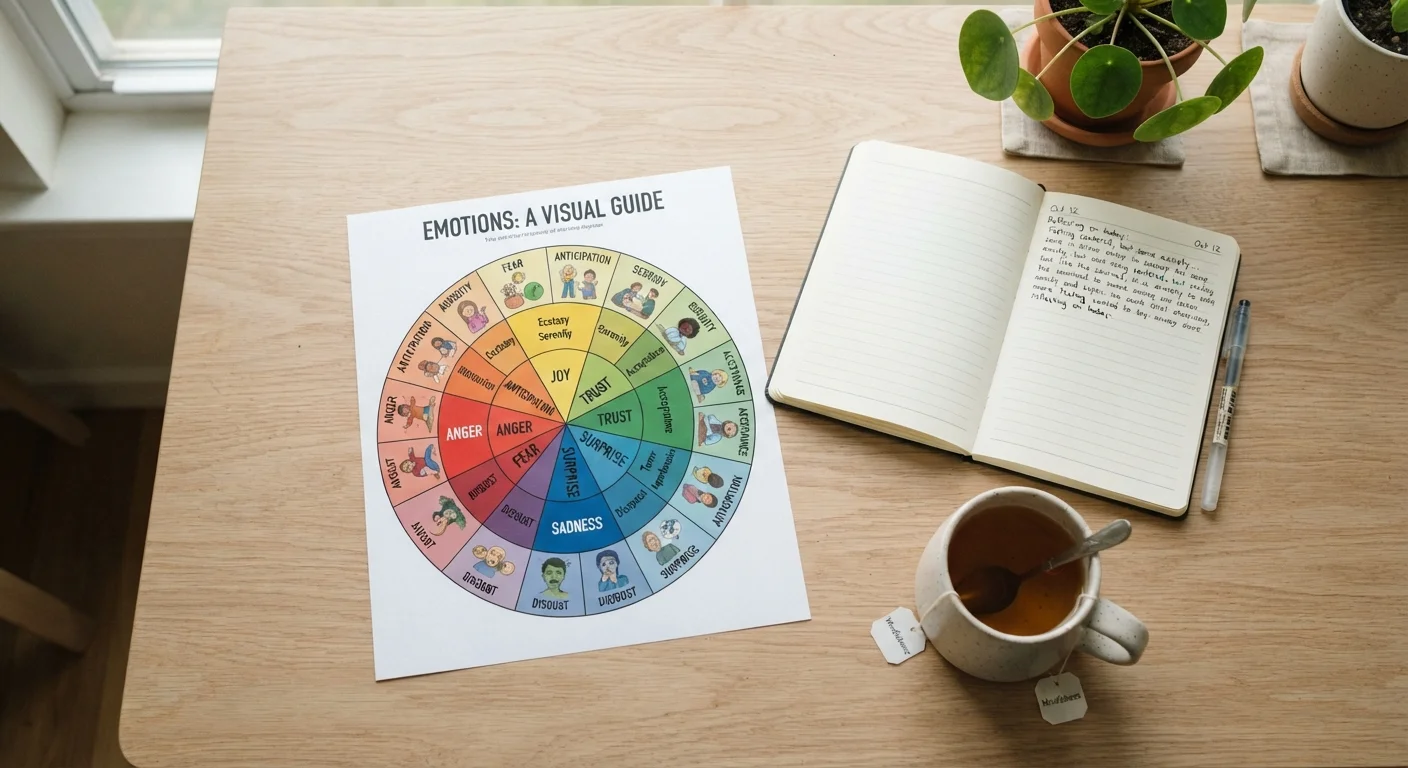
Vague labels like "bad" or "stressed" are less useful than specific ones like "disappointed," "overstimulated," or "lonely." Greater emotional granularity — the ability to distinguish between similar feelings — is associated with better emotion regulation. If you struggle to find the right word, the emotion wheel is a practical reference to keep nearby while you write.
What You'll Need Before You Start
Mood journaling has a low barrier to entry, but a few decisions upfront will make the habit stick.
What you will need
One choice worth thinking through before your first entry: will you journal by hand or digitally? Handwriting tends to slow your thinking in a productive way, while apps can offer built-in prompts and mood-rating scales. Neither approach is superior — consistency matters far more than medium. If you'd like help identifying what emotional experiences you're even trying to describe, the emotion wheel is a useful companion tool for naming feelings more precisely before you write them down.
How to Build Your Mood Journaling Practice
The steps below take you from your very first entry to the review process where patterns become visible. Work through them at whatever pace feels sustainable — most people find a rhythm within two weeks.
Choose a format and anchor it to an existing habit
Decide whether you'll write free-form prose, use a structured template (mood rating, trigger, body sensation, thought), or a hybrid. Then attach your journaling session to something you already do — right after morning coffee, at lunch before eating, or as part of a wind-down routine. Habit stacking like this dramatically improves follow-through.
Write your first entry using context, not just labels
Open your journal and record the time, your mood rating, and the emotion you'd assign to the moment. Then add one or two sentences of context: what happened in the last few hours, how your body feels, and what thought is loudest right now. Context is what transforms a mood log into usable data.
Example entry structure:
- Time: 7:45 AM
- Mood (1–10): 5
- Emotion: Anxious
- Context: Big presentation at 10 AM; slept poorly; shoulders feel tight.
- One thought: "I don't think I'm ready."
Check in at least once daily for two weeks
Consistency over a minimum of 14 days is what generates enough data to spot patterns. Even a 60-second entry on a rushed day is more valuable than skipping entirely. If you miss a day, simply resume the next — there's no need to backfill or apologize to yourself.
Review your entries at the end of each week
After seven days, read back through your entries and look for recurring themes: Which emotions appeared most often? Were there specific times of day, people, or situations associated with low-mood entries? Did anything reliably lift your mood? Note observations in a brief summary at the end of the week — this becomes the backbone of your self-awareness practice.
Use your patterns to shape small, intentional changes
Once you can see a pattern — say, mood reliably drops mid-afternoon on days with back-to-back meetings — you have actionable information. Experiment with one small structural change at a time: a brief walk, a five-minute mindfulness pause, or a buffer between commitments. Track whether the change shifts your mood entries over the following week. This is how journaling moves from reflection to real-life impact. For broader habit review, a daily health habits checklist can help you see where emotional and physical patterns intersect.
If stress patterns surface during your review, the stress levels self-assessment can help you decide whether what you're noticing warrants additional attention or support.
This article is for informational purposes only and does not constitute medical or psychological advice. If you are experiencing persistent emotional distress, please consult a qualified mental health professional.