
Why Identifying Emotions Is Harder Than It Sounds
Most of us were never formally taught to identify what we're feeling. We learn a handful of emotion words early on—happy, sad, angry, scared—and then spend the rest of our lives trying to make those broad categories fit experiences that are often far more layered. The result is a kind of emotional blur: you know something feels wrong, but you can't quite name it, and without a name, it's difficult to know what to do about it.
This is where the emotion wheel becomes genuinely useful. Rather than leaving you to rummage through a limited vocabulary, it lays out the emotional landscape in an organized, visual way. Psychologist Lisa Feldman Barrett's research on emotional granularity—the ability to make fine-grained distinctions between similar feelings—suggests that people who can do this well tend to manage stress more effectively and show greater psychological resilience. The emotion wheel is essentially a granularity training tool.
Emotions also register in the body, not just the mind—a tight chest, a hollow stomach, a sudden wave of heat. Pairing physical awareness with the wheel's vocabulary can sharpen your ability to name what's happening in real time.
How the Emotion Wheel Is Structured
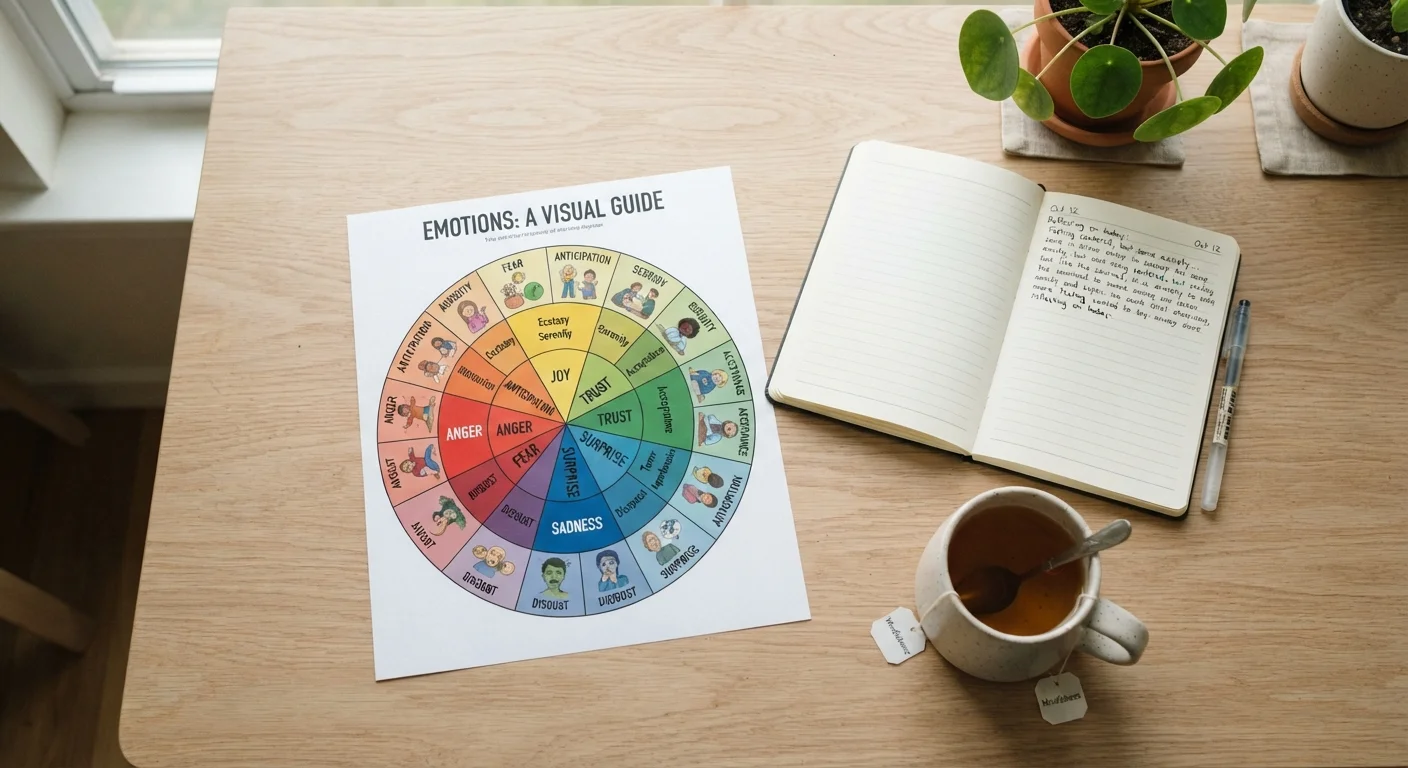
The typical emotion wheel is organized as concentric rings. At the center sit a small number of core, primary emotions—commonly joy, sadness, anger, fear, disgust, and surprise. These are the broad anchors. Moving outward through the rings, each emotion branches into more specific variants. 'Anger,' for example, might expand to 'frustrated,' then to 'irritated' or 'furious' depending on intensity and context. 'Joy' might branch toward 'content,' 'grateful,' or 'ecstatic.'
The outer edges of the wheel capture emotions that are harder to pin down in everyday conversation—feelings like 'remorse,' 'pensiveness,' 'serenity,' or 'apprehension.' These are the emotions people often describe as 'I don't know, I just feel off.' Having a word for them doesn't just satisfy curiosity; it activates a different kind of processing in the brain. Research in affective neuroscience suggests that labeling an emotion—what scientists call affect labeling—can reduce the intensity of that emotion's grip on you.
~27
Distinct emotional categories identified in research
A 2017 study published in PNAS by Cowen and Keltner identified approximately 27 distinct categories of human emotion, challenging earlier models that posited only six to eight basic emotions.
Higher
Distress tolerance in high emotional granularity individuals
Research by psychologist Lisa Feldman Barrett and colleagues found that people with greater emotional granularity—those who distinguish between similar feelings more precisely—tend to show better stress regulation and lower reactivity.
It's worth noting that no single wheel is definitive. Plutchik's original model differs from later clinical adaptations and from the wheels used in educational settings. What matters is finding a version that resonates and using it consistently, not treating any one diagram as the final word on human feeling.
Putting the Wheel to Work in Everyday Life
Using the emotion wheel doesn't require a formal practice or a lot of time. The simplest approach: when you notice you're feeling something strongly—or numbly—pull up the wheel and start at the center. Find the broad category that seems closest, then move outward until a word makes you pause and think yes, that's it.
Some people keep a printed or digital version of the wheel accessible during stressful moments at work or home. Others use it as part of a regular journaling practice. Mood journaling combined with the emotion wheel is particularly effective for spotting patterns—noticing, for instance, that what you label 'stress' on Sunday evenings is actually closer to 'dread' tied to specific anticipatory thoughts.
The wheel is also a useful bridge when emotions are driving reactions you don't fully understand. If you snapped at someone and aren't sure why, the wheel can help you trace backward: Were you embarrassed? Overwhelmed? Feeling unheard? Understanding the actual emotion often reveals the underlying need—rest, recognition, reassurance—which gives you something concrete to address. For a deeper look at how feelings can hijack behavior before you realize it, learning about emotional triggers is a natural next step.
A Note on Positive Emotions Too
The emotion wheel isn't only for difficult feelings. Many people find it equally illuminating on the positive side, where we tend to flatten everything into 'good' or 'happy.' There's a meaningful difference between feeling content and feeling elated, between grateful and relieved, between proud and inspired. Each of those states arises from different circumstances and calls for a different kind of attention.
Positive emotions are more complex than they might seem—they each activate different responses in the brain and body, and recognizing them individually can help you understand what genuinely nourishes you versus what only temporarily distracts you.
Think of the emotion wheel as an ongoing practice rather than a one-time fix. The goal isn't to become hyper-analytical about every feeling; it's to build enough fluency with your emotional life that you can respond thoughtfully rather than react automatically. That capacity—sometimes called emotional intelligence—is a learnable skill, and the wheel is one of the more accessible tools for developing it.
This article is for general informational and educational purposes only and does not constitute medical or psychological advice. If you are experiencing persistent emotional distress, please consult a qualified mental health professional.