
Why Routine Childhood Vaccines Matter
Routine childhood immunizations are among the most effective tools in preventive medicine. By training the immune system to recognize specific pathogens before exposure occurs, vaccines reduce the risk of serious illness, hospitalization, and complications — for the child vaccinated and for those around them who cannot be vaccinated due to age or medical conditions.
The CDC and the American Academy of Pediatrics (AAP) publish an updated immunization schedule each year. This reference covers the core vaccines on that schedule, what disease each one targets, and the general timing windows in which doses are given. Always consult your child's pediatrician for personalized guidance, as schedules can vary based on a child's health history.
For a broader look at how vaccines build immunity, see our complete starter guide to vaccines and immunity.
| Diseases prevented by routine childhood schedule | 14+ (CDC Childhood Immunization Schedule) |
| First vaccine typically given | Hepatitis B (at birth) (CDC, AAP) |
| Annual vaccine recommended from age | 6 months (influenza) (CDC Advisory Committee on Immunization Practices) |
| HPV vaccine recommended starting age | 11–12 years (CDC ACIP) |
| Meningococcal booster timing | Age 16 (after initial dose at 11–12) (CDC Adolescent Immunization Schedule) |
Core Vaccines and the Diseases They Prevent
The following vaccines are included in the standard U.S. childhood immunization schedule. Timing listed reflects typical CDC recommendations; your child's provider will confirm the right schedule for your family.
HepB — Hepatitis B
Protects against a viral liver infection that can become chronic and lead to liver disease or liver cancer. Three doses are typically given, with the first at birth.
DTaP — Diphtheria, Tetanus, and Pertussis
A combination vaccine covering three bacterial diseases. Diphtheria can cause a thick throat coating that obstructs breathing. Tetanus causes painful muscle stiffening (often called lockjaw). Pertussis (whooping cough) causes severe coughing fits dangerous to infants. Five doses are given between 2 months and 4–6 years.
Hib — Haemophilus influenzae type b
Prevents bacterial meningitis, pneumonia, and epiglottitis in young children. Two to four doses are administered between 2 and 15 months, depending on the brand used.
PCV15 / PCV20 — Pneumococcal Conjugate
Guards against Streptococcus pneumoniae, a leading cause of bacterial meningitis, bloodstream infections, and pneumonia in children. Four doses are given between 2 months and 12–15 months.
IPV — Inactivated Poliovirus
Protects against polio, a disease that can cause permanent paralysis. Four doses are given between 2 months and 4–6 years.
MMR — Measles, Mumps, and Rubella
A combination vaccine targeting three viral diseases. Measles can cause encephalitis and death. Mumps can lead to deafness. Rubella during pregnancy causes serious birth defects. Two doses are given, typically at 12–15 months and 4–6 years.
Varicella — Chickenpox
Prevents chickenpox, which can lead to bacterial skin infections, pneumonia, and encephalitis. Two doses are given at 12–15 months and 4–6 years.
HepA — Hepatitis A
Protects against a highly contagious liver infection spread through contaminated food or water. Two doses are given between 12 and 23 months.
RV — Rotavirus
Prevents rotavirus, the most common cause of severe diarrhea and vomiting in infants, which can lead to dangerous dehydration. Two or three oral doses are given between 2 and 6 months.
Influenza (Flu)
An annual vaccine recommended for all children 6 months and older. Each year's formulation is updated to match circulating strains.
COVID-19
Recommended for children 6 months and older per the current CDC schedule. Consult your child's provider regarding series completion and updated booster guidance.
MenACWY — Meningococcal
Protects against bacterial meningitis caused by Neisseria meningitidis groups A, C, W, and Y. Typically given at 11–12 years with a booster at 16.
HPV — Human Papillomavirus
Prevents infection with HPV strains that cause most cases of cervical cancer, other anogenital cancers, and genital warts. Recommended starting at age 11–12; two doses suffice when the series begins before age 15.
Immunization
The process of becoming protected against a disease, usually through vaccination. Immunization stimulates the immune system to build a defense without causing the disease itself.
Conjugate Vaccine
A type of vaccine that links a weak antigen to a carrier protein to produce a stronger immune response, particularly effective in infants and young children.
Combination Vaccine
A single vaccine that protects against more than one disease at once — such as DTaP, which covers diphtheria, tetanus, and pertussis — reducing the number of injections needed.
Booster Dose
An additional vaccine dose given after the initial series to maintain or strengthen immunity over time, as protection from some vaccines can wane.
Herd Immunity
When a sufficiently large proportion of a population is immune to a disease — through vaccination or prior infection — reducing the likelihood that susceptible individuals will be exposed.
Attenuated Vaccine
A vaccine made with a weakened form of the live pathogen. It typically produces a strong, long-lasting immune response. The MMR and varicella vaccines are examples.
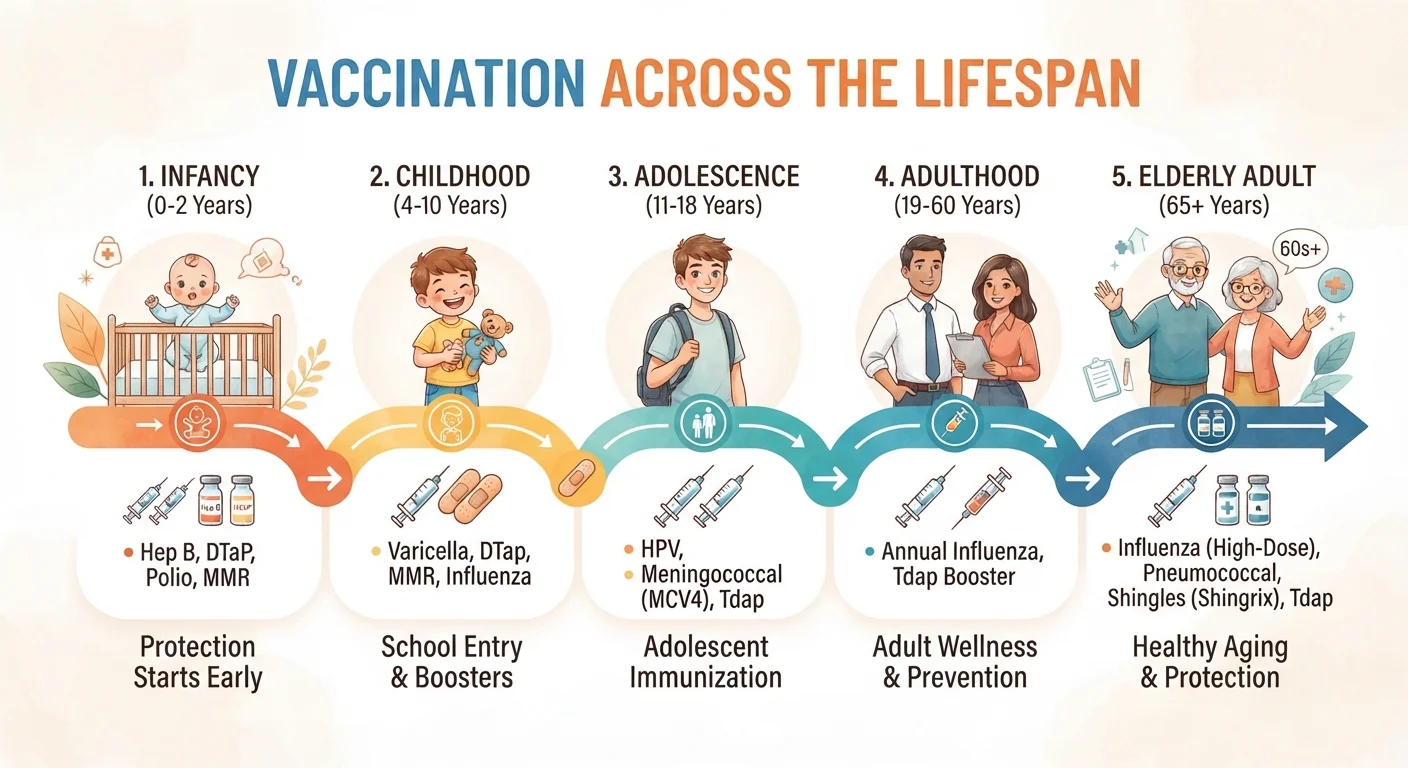
For a full lifecycle view, the immunization timeline across a lifetime maps how vaccine needs evolve from infancy through older adulthood.
Staying Organized and What Comes Next
Keeping accurate immunization records helps ensure no doses are missed — especially important during school enrollment, travel, or when changing healthcare providers. Our guide on keeping your vaccination records in order offers practical steps for organizing that history.
Childhood immunization also sets the foundation for adult health. Many adults unknowingly have gaps in their vaccination history. The article vaccines commonly missed in adulthood explores which shots frequently fall through the cracks and why.
If you have questions about your child's specific schedule — particularly for children with underlying health conditions, allergies, or who are immunocompromised — speak directly with a licensed pediatrician or family medicine provider. They can tailor recommendations based on your child's complete health picture.
This article is for informational purposes only and is not medical advice. Always consult a qualified healthcare professional for guidance specific to your child's health needs.