Your Environment Is Part of Your Sleep Biology
Most people think of a comfortable bedroom as a nicety — a preference rather than a physiological necessity. Sleep science tells a different story. Temperature, light, and noise don't just influence how quickly you fall asleep; they interact directly with the hormonal and neurological systems that govern sleep stages, circadian rhythms, and restorative processes like memory consolidation and tissue repair.
Understanding how these factors work — not just that they matter — gives you a clearer framework for making meaningful changes. The list below breaks down each environmental variable and its specific biological mechanism, drawing on established sleep research. For a broader look at how these factors play out in practice, see our overview of the sleep environment.
Bedroom temperature triggers the body's sleep-onset signal
Sleep initiation depends on a process called distal vasodilation — the widening of blood vessels in the hands and feet to release heat and lower core body temperature. Research consistently shows that core temperature needs to drop by approximately 1–2°F for the brain to transition into sleep. When the ambient environment is too warm, this heat-loss mechanism is impaired, making sleep onset harder and lighter sleep stages more likely.
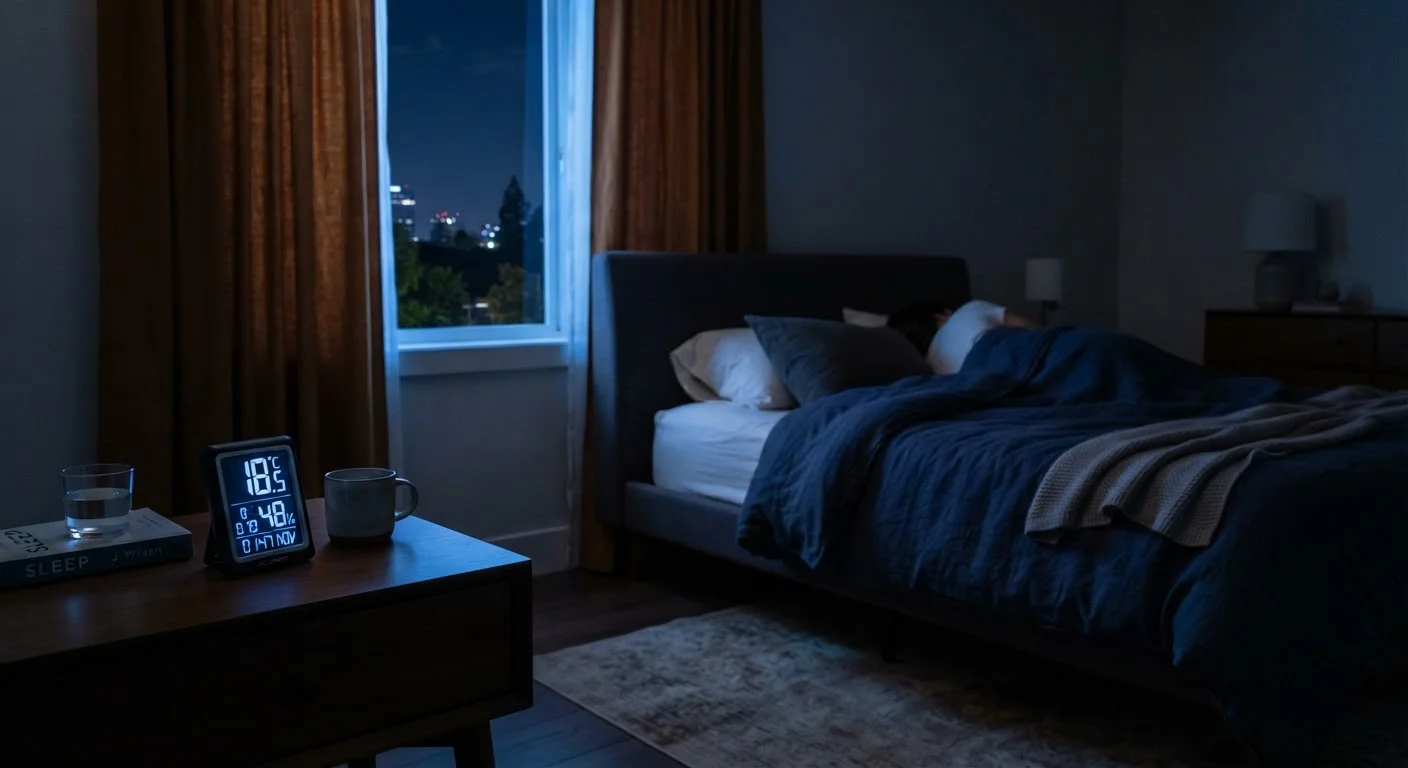
Most sleep researchers point to a bedroom temperature range of roughly 65–68°F (18–20°C) as conducive to this process for most adults, though individual variation exists. Notably, temperature regulation also affects slow-wave sleep (SWS) — the deepest, most physically restorative stage. Studies using thermosuit protocols have found that warming the skin surface (which promotes internal cooling) can increase SWS duration, suggesting the thermal environment continues to shape sleep architecture throughout the night, not just at onset.
Core body temperature must fall for sleep to begin — your bedroom's warmth directly controls that process.
Light exposure regulates melatonin and the circadian clock
The human circadian system is entrained primarily by light detected through a specialized subset of retinal cells containing a photopigment called melanopsin. These cells are especially sensitive to short-wavelength (blue) light and project directly to the suprachiasmatic nucleus (SCN) — the brain's master circadian pacemaker. Light reaching these cells in the hours before bed signals the SCN to suppress melatonin release from the pineal gland, effectively delaying the biological sleep window.
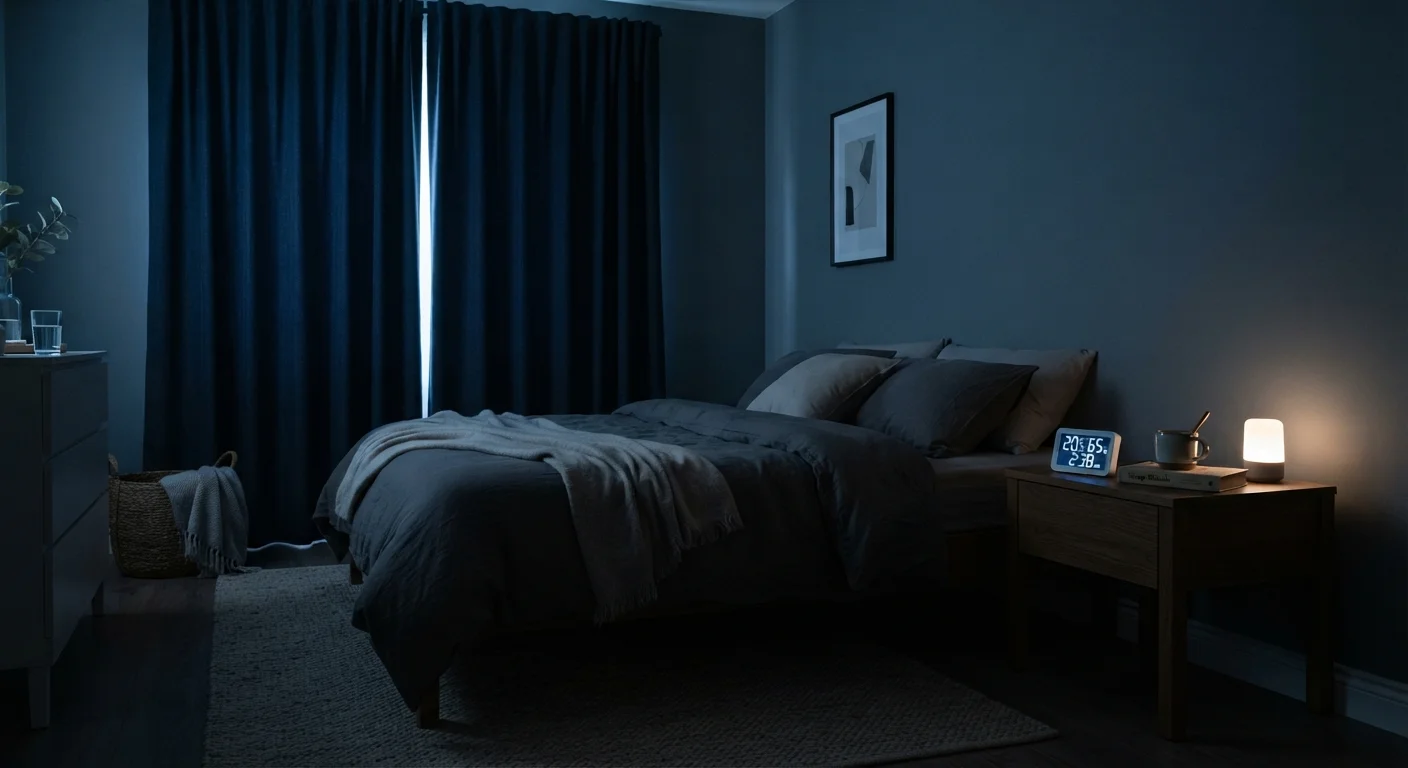
Research has demonstrated that even relatively dim indoor lighting — far below typical office levels — can measurably suppress melatonin compared to dim conditions. Conversely, morning light exposure helps advance the circadian phase, making it easier to feel alert earlier and fall asleep at an appropriate time. Blackout curtains, limiting screen use in the hour before bed, and keeping nightlights dim and amber-toned are practical strategies grounded in this photobiology. For more on how light fits into broader sleep habits, see what sleep hygiene really covers.
Even low-level light before bed can blunt melatonin, pushing your biological sleep window later.
Noise disrupts sleep architecture, not just sleep onset
Sound's primary threat to sleep isn't the obvious one — being jolted awake — though that happens too. More insidious is its effect on sleep microstructure. Even noise that doesn't cause full arousal can trigger cortical arousals (brief shifts toward lighter sleep stages) and suppress time spent in slow-wave and REM sleep. Traffic noise, aircraft flyovers, and partner movement sounds have all been shown in polysomnographic studies to fragment sleep architecture in ways sleepers often don't consciously register.
What makes noise particularly disruptive is its unpredictability. The brain's auditory system remains partially active during sleep and continues evaluating sounds for threat relevance. Sudden or variable sounds are processed as higher-priority signals than steady background noise. This is why consistent masking sounds — such as white noise, pink noise, or a fan — can be more protective than silence in noisy environments: they raise the detection threshold uniformly rather than leaving the brain scanning a quiet baseline for sporadic stimuli. Bedroom environment science explores how acoustic management fits alongside other physical sleep variables.
Unpredictable sounds fragment sleep architecture even without waking you — your brain never fully stops listening.
Humidity and air quality compound the temperature effect
Temperature doesn't operate in isolation. High relative humidity impairs the body's ability to dissipate heat through sweat evaporation, making a warm room feel subjectively hotter and further interfering with the core temperature drop required for sleep. Studies examining thermal comfort in sleep contexts consistently find that humidity levels above roughly 70% reduce sleep quality even when temperature is controlled.
Air quality — specifically particulate matter, volatile organic compounds (VOCs), and carbon dioxide buildup in enclosed bedrooms — is an emerging area of sleep environment research. Elevated CO₂ concentrations in poorly ventilated rooms have been associated with increased nighttime awakenings and reduced next-day cognitive performance in some studies. Adequate ventilation, without introducing disruptive noise or light, appears to support both the thermal and respiratory aspects of the sleep environment.
High humidity undermines the body's heat-loss mechanism, compounding the negative effects of a warm room.
Light timing matters as much as light intensity
The circadian system is sensitive to the timing of light exposure, not just its presence. Bright light in the early morning reinforces an earlier circadian phase, while bright light in the late evening delays it. This temporal sensitivity explains why the same overhead lamp can have very different biological consequences depending on when it is switched on. Shift workers and frequent travelers experience compounded disruption precisely because light exposure falls out of alignment with their target sleep schedule.
For most people with conventional schedules, the practical implication is straightforward: prioritize bright light — ideally natural daylight — in the morning, and begin dimming the environment one to two hours before the intended sleep time. This gradient supports the natural rise in melatonin that precedes physiological sleepiness, without requiring strict darkness earlier in the evening when social and family activities often make that impractical.
Morning light and evening dimming work together — the timing of light exposure shapes your entire circadian rhythm.
Sound masking works differently from eliminating noise
A common misconception is that the quietest possible environment is always optimal. In practice, for many people — particularly urban dwellers or light sleepers — complete silence can be harder to maintain and can actually heighten sensitivity to sudden acoustic intrusions. Sound masking works by providing a continuous, spectrally consistent background that narrows the contrast between ambient sound levels and intrusive peaks.
Pink noise (which weights lower frequencies more heavily than white noise) has attracted research interest for its potential to enhance slow-wave sleep and sleep-dependent memory consolidation in some studies, though this remains an active area of investigation rather than settled consensus. The key variable appears to be consistency and low variability rather than any specific noise color. Fans, air purifiers, and dedicated sound machines all achieve the masking effect through different spectral profiles — the practical goal is reducing acoustic surprise, not achieving a particular decibel level.
Consistent background sound reduces acoustic contrast — it's the unpredictable spikes, not sound itself, that fragment sleep.
Putting the Science Into Practice
Each of the factors above operates through a distinct biological pathway, yet they interact. A cool room amplifies the body's natural temperature drop; a dark room ensures melatonin release isn't blunted; a quiet — or consistently masked — acoustic environment keeps the brain's arousal threshold high enough to sustain slow-wave and REM sleep. Optimizing all three together is more effective than targeting just one.
Start With One Change at a Time
Overhauling temperature, light, and noise simultaneously can make it hard to identify which adjustment had the most impact on your sleep. Consider changing one variable per week — cooling the room first, then addressing light, then sound — and tracking how you feel each morning. This incremental approach also makes new habits easier to sustain. If sleep difficulties persist despite environmental improvements, speak with a healthcare provider.
These environmental principles sit at the heart of evidence-based sleep hygiene. For a fuller look at the behavioral and lifestyle habits that complement a well-designed sleep environment, explore the evidence-based habits that improve sleep quality and the full picture on sleep biology and environment.
This article is for general informational and educational purposes only and does not constitute medical advice. If you have concerns about your sleep health or a suspected sleep disorder, consult a qualified healthcare professional.