Why Metabolism Myths Are So Persistent
Metabolism — the set of chemical processes your body uses to convert food into energy — sits at the center of countless health claims. Because it's invisible, complex, and genuinely variable between individuals, it's fertile ground for oversimplification. Wellness culture, social media, and even well-meaning fitness advice have kept several misconceptions alive for decades despite clear scientific evidence to the contrary.
If you're new to the topic, our introductory guide to metabolism lays a solid foundation before diving into these corrections. What follows addresses the most persistent myths — and what the evidence actually shows.
Myth
Eating small, frequent meals throughout the day boosts your metabolism and helps burn more calories.
Fact
Meal frequency has no meaningful effect on total daily energy expenditure. What drives metabolic rate is total calorie intake and composition, not how often you eat.
The idea that eating every two to three hours "keeps your metabolism fired up" became popular in fitness circles, but controlled research hasn't supported it. Each time you eat, your body expends a small amount of energy digesting food — a process called the TEF. However, TEF is proportional to the total calories consumed, not the number of eating occasions. Splitting 2,000 calories across six meals produces the same total TEF as eating them across three. A 2015 review in Nutrition Reviews found no evidence that increased meal frequency improves metabolic rate or body composition when total energy intake is held equal.
Myth
Some people are just born with a slow metabolism and can't do anything about it.
Fact
While genetics influence metabolic rate, lifestyle factors — particularly muscle mass and physical activity — play a significant and modifiable role.
Resting metabolic rate (RMR) does vary between individuals, and genetics account for some of that variation. But research consistently shows that body composition, particularly lean muscle mass, is one of the strongest predictors of RMR. Skeletal muscle is metabolically active tissue — it burns more calories at rest than fat tissue does. This means building and preserving muscle through resistance training can meaningfully influence how many calories your body burns daily. For a nuanced look at what "fast" or "slow" metabolism actually means in practice, see our piece on fast vs. slow metabolism.
Myth
Adding muscle dramatically raises your resting metabolism and burns hundreds of extra calories per day.
Fact
Muscle does increase resting metabolic rate, but the effect per pound is modest — roughly 6–10 calories per pound of muscle per day, not the commonly cited figures of 50 or more.
Resistance training is genuinely valuable for metabolic health, but the magnitude of its direct caloric impact is frequently overstated. Research estimates that each pound of muscle burns approximately 6 to 10 calories per day at rest, compared to roughly 2 calories per pound of fat. Gaining five pounds of muscle — a significant achievement requiring months of consistent training — would add perhaps 30 to 50 extra calories burned daily. That's meaningful over time, but it's not a metabolic transformation. The broader benefits of strength training — improved insulin sensitivity, bone density, and functional capacity — remain well-established and compelling on their own terms.
Myth
Sweating more during exercise means you're burning more calories and boosting your metabolism.
Fact
Sweat is your body's cooling mechanism, not a measure of caloric output. How much you sweat is influenced by temperature, humidity, fitness level, and individual physiology.
This myth likely persists because intense exercise often produces both heavy sweating and high calorie burn simultaneously — but correlation isn't causation. A person exercising in a hot room may sweat profusely without burning significantly more calories than they would in a cooler environment doing identical work. Conversely, a highly trained athlete may burn many calories while sweating less than a beginner at the same intensity, because cardiovascular fitness makes thermoregulation more efficient. Caloric expenditure during exercise is better estimated by intensity, duration, and body weight — not sweat volume.
Myth
Eating late at night slows your metabolism and causes weight gain.
Fact
Your metabolism doesn't shut down at night. Weight gain from late-night eating, when it occurs, is typically explained by total excess calorie intake — not the timing itself.
The body continues to burn calories around the clock to support basic functions like breathing, circulation, and cell repair. While some research suggests that circadian rhythms may influence how efficiently calories are processed at different times of day, the effect size in most studies is small and context-dependent. The more practical explanation for weight gain associated with late-night eating is behavioral: evening snacking often adds calories on top of an already adequate day's intake, and snack choices tend to be calorie-dense. Controlling total daily intake remains the primary driver of energy balance, regardless of when meals occur.
What These Corrections Mean for Your Health Decisions
Understanding metabolism accurately changes how you interpret diet advice and fitness recommendations. When you recognize that meal timing has minimal metabolic impact, for example, you can focus on what genuinely matters: overall food quality, energy balance, and sustainable habits.
~60–70%
Of daily calories burned at rest
Resting metabolic rate accounts for the majority of total daily energy expenditure, according to estimates from the National Institutes of Health.
Stable 20–60
Age range with consistent metabolic rate
A large-scale 2021 study published in Science found that total energy expenditure remains relatively stable between ages 20 and 60 when adjusted for body size.
~10%
Of calories burned through digestion (TEF)
The thermic effect of food — energy spent digesting and metabolizing meals — accounts for roughly 10% of total daily energy expenditure for most people.
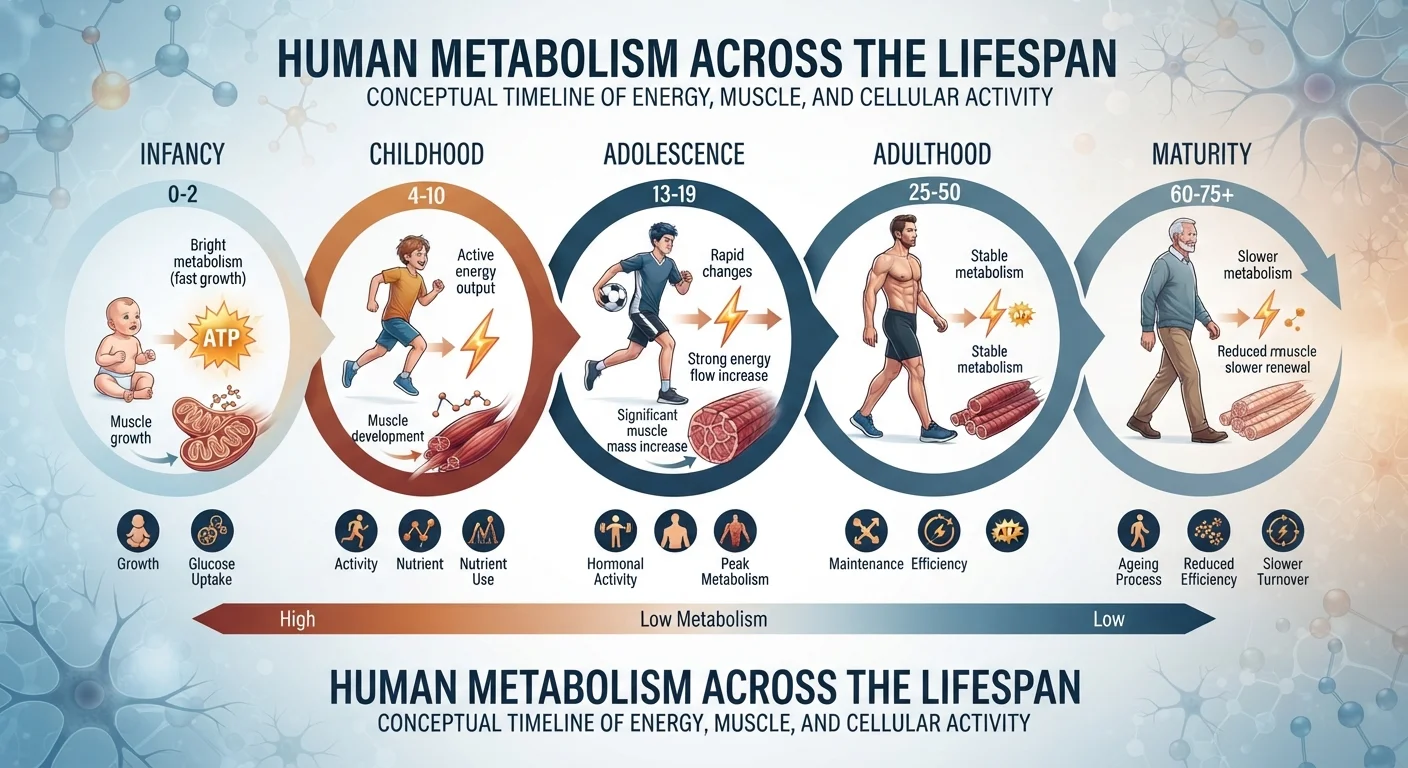
It's also worth knowing that while metabolic rate does shift over time, the degree to which aging alone drives that change is often exaggerated. Research published in Science in 2021 found that metabolism stays relatively stable between ages 20 and 60, with declines becoming more pronounced after 60. Much of what people attribute to an inevitable metabolic slowdown in middle age may actually reflect declining muscle mass and reduced physical activity — both of which are modifiable. Our article on age and metabolism explores which changes are biological and which are driven by lifestyle choices.
Believing inaccurate metabolic claims can lead to genuinely counterproductive decisions — crash diets, unnecessary supplements, or abandoning effective exercise habits. For a deeper look at those downstream consequences, see our coverage of metabolism misconceptions that lead people astray. And if weight management is a concern, it's worth reading about weight management myths that circulate alongside metabolic ones.
This article is for general informational purposes only and does not constitute medical advice. For questions about your individual metabolism, weight, or health status, consult a qualified healthcare professional.