Why 'Positive' Is Not One Thing
Most of us grow up sorting feelings into two bins: good and bad. Happiness goes in the good bin. Sadness, anger, and anxiety go in the bad one. It's a tidy system — but it misses most of what's actually happening when we feel something.
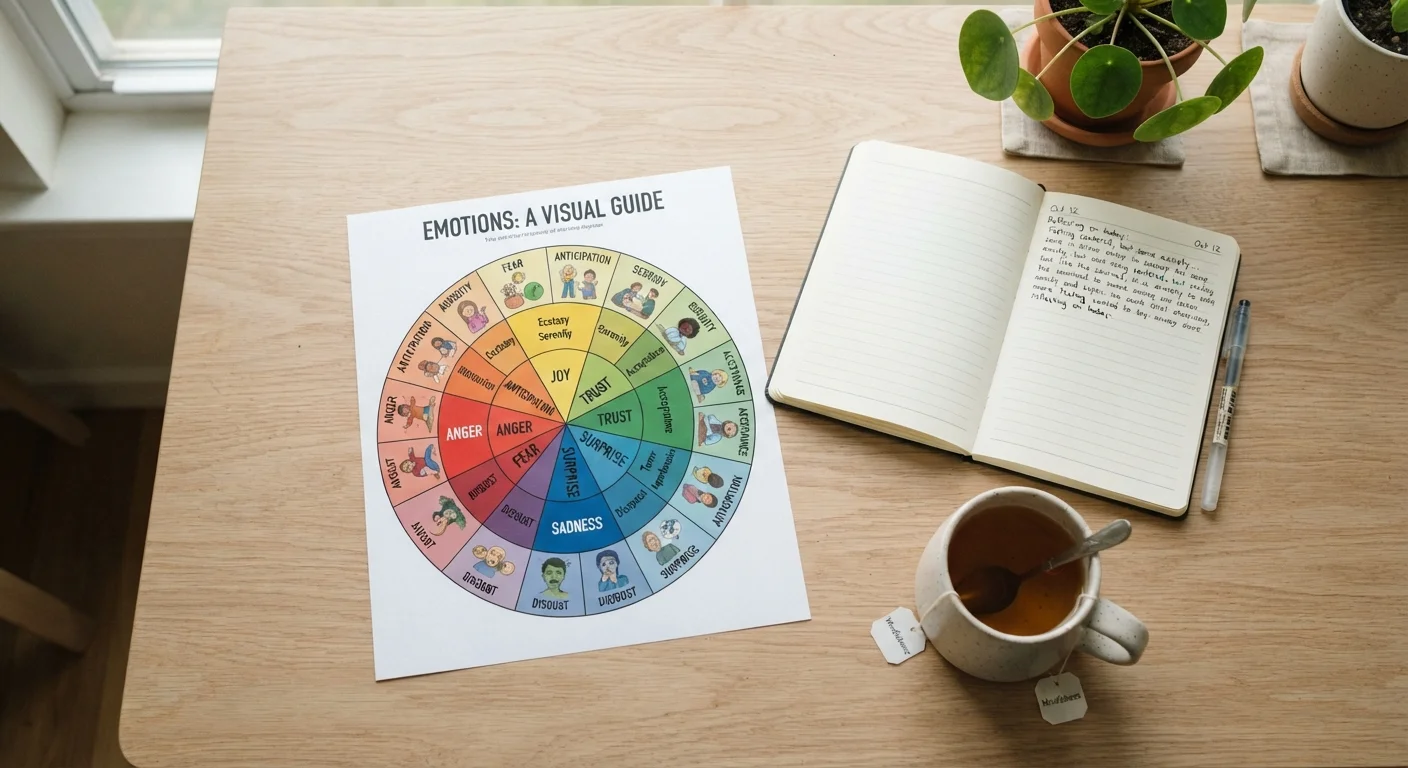
Psychological research has catalogued at least ten to seventeen distinct positive emotions, each with its own trigger, its own physical signature, and its own effect on thinking and behavior. Joy is not the same as contentment. Gratitude is not the same as pride. Awe is in a category almost entirely its own. Understanding these differences is more than an academic exercise — it directly shapes how well we can recognize what we're feeling, communicate it, and use it. The emotion wheel is one practical tool for doing exactly that kind of fine-grained sorting.
Getting more precise also helps separate two fundamentally different types of well-being: hedonic (feeling good) and eudaimonic (living meaningfully). Some positive emotions — like pleasure or excitement — lean hedonic. Others — like elevation or awe — point more toward meaning. Both matter, but they produce different outcomes over time.
| Number of distinct positive emotions identified in research | At least 10–17 (Fredrickson, B.L., Review of General Psychology, 1998) |
| Broaden-and-build theory origin | Proposed by Barbara Fredrickson (American Psychologist, 2001) |
| Awe and inflammation link | Awe associated with lower pro-inflammatory cytokines (Stellar et al., Emotion, 2015) |
| Gratitude and sleep quality | Gratitude journaling linked to better sleep (Wood et al., Journal of Psychosomatic Research, 2009) |
| Contentment vs. excitement arousal level | Contentment is low-arousal; excitement is high-arousal (Russell's Circumplex Model of Affect) |
A Closer Look at Key Positive Emotions
Here is how several commonly grouped emotions actually differ:
- Joy is typically high-intensity, high-arousal, and often spontaneous. It tends to arise from unexpected good fortune or social connection and is short-lived.
- Contentment is low-arousal and stable. It signals that things are as they should be. Unlike joy, it doesn't demand anything of you — it simply settles.
- Gratitude is inherently relational. It arises when you recognize that something good came through someone else's effort or care. Research consistently links gratitude practice to improved sleep quality and stronger social bonds.
- Awe is triggered by vastness — physical, intellectual, or moral — that briefly overwhelms your current mental frameworks. Studies suggest awe may reduce certain inflammatory markers and increase a sense of connection to something larger than oneself.
- Elevation is the warm, chest-expanding feeling that comes from witnessing genuine moral beauty. It is distinct from admiration and appears to motivate prosocial behavior in the observer.
- Hope is future-oriented and requires uncertainty — you can only hope for what isn't yet guaranteed. It is cognitively active, involving goal-directed thinking, rather than a passive pleasant sensation.
These emotions also differ in how they register in the body. To understand the physical dimension more deeply, see our article on how emotions show up physically.
Hedonic well-being
A measure of well-being focused on the presence of pleasant feelings and the absence of unpleasant ones. It captures how good a person feels day to day, rather than how meaningful they find their life.
Eudaimonic well-being
A form of well-being rooted in purpose, growth, and meaning rather than pleasure alone. Research suggests it is associated with distinct long-term health outcomes compared to hedonic well-being.
Broaden-and-build theory
A psychological framework proposed by researcher Barbara Fredrickson suggesting that positive emotions expand a person's momentary thought-action repertoire, which over time helps build lasting personal resources such as resilience and social connection.
Awe
An emotion triggered by encountering something vast or beyond one's current understanding — a mountain view, a piece of music, or a moment of profound human achievement. Research links awe to reduced inflammatory markers and increased prosocial behavior.
Elevation
A warm, motivating feeling that arises from witnessing moral beauty or exceptional kindness. Elevation is distinct from general happiness and appears to increase a person's own desire to act generously.
Affect valence
The positive or negative quality assigned to an emotional experience. Valence alone does not capture the full character of an emotion — two feelings can both be positive yet differ markedly in arousal, duration, and behavioral effect.
What This Means for Everyday Emotional Health
Recognizing the texture of what you're feeling — rather than just its valence — has real practical value. When you can distinguish restless excitement from settled contentment, you can make better decisions about what you actually need. When you notice that what you're feeling is elevation after witnessing generosity, you can use that momentum intentionally.
Psychologist Barbara Fredrickson's broaden-and-build theory offers a useful frame: positive emotions, even brief ones, expand the range of thoughts and actions available to us in the moment. Over time, that expanded awareness accumulates into lasting resources — stronger relationships, greater flexibility, and better stress recovery. This is part of what makes emotional resilience not just about handling hard times, but about cultivating the good ones with intention.
One practical starting point: try naming what you feel with more specificity. Instead of "I feel good," ask whether it's closer to relief, pride, or quiet satisfaction. This kind of precision — what researchers call emotional granularity — is associated with better emotional regulation and mental health outcomes across multiple studies.
It's also worth noting that understanding your positive emotions complements how you handle negative ones. The contrast between reacting versus responding to difficult emotions becomes clearer when you have a richer map of your full emotional landscape.
This article is for informational purposes only and is not a substitute for professional mental health advice, diagnosis, or treatment. Please consult a qualified healthcare provider with any questions about your mental health.