
Emotions Live in the Body, Not Just the Mind
Most of us learned to think of emotions as something that happens in our heads — a thought, a mood, a mental state. But science tells a different story. Emotions are whole-body events, coordinated by the brain and nervous system, expressed through flesh, muscle, and organ.
A 2013 study published in PNAS (Proceedings of the National Academy of Sciences) by researchers in Finland asked hundreds of participants to map where in their bodies they felt specific emotions. The results were remarkably consistent: anger activated the chest and arms; love radiated upward through the torso; depression quieted nearly everything. These maps held across cultures, suggesting a universal biological architecture beneath human feeling.
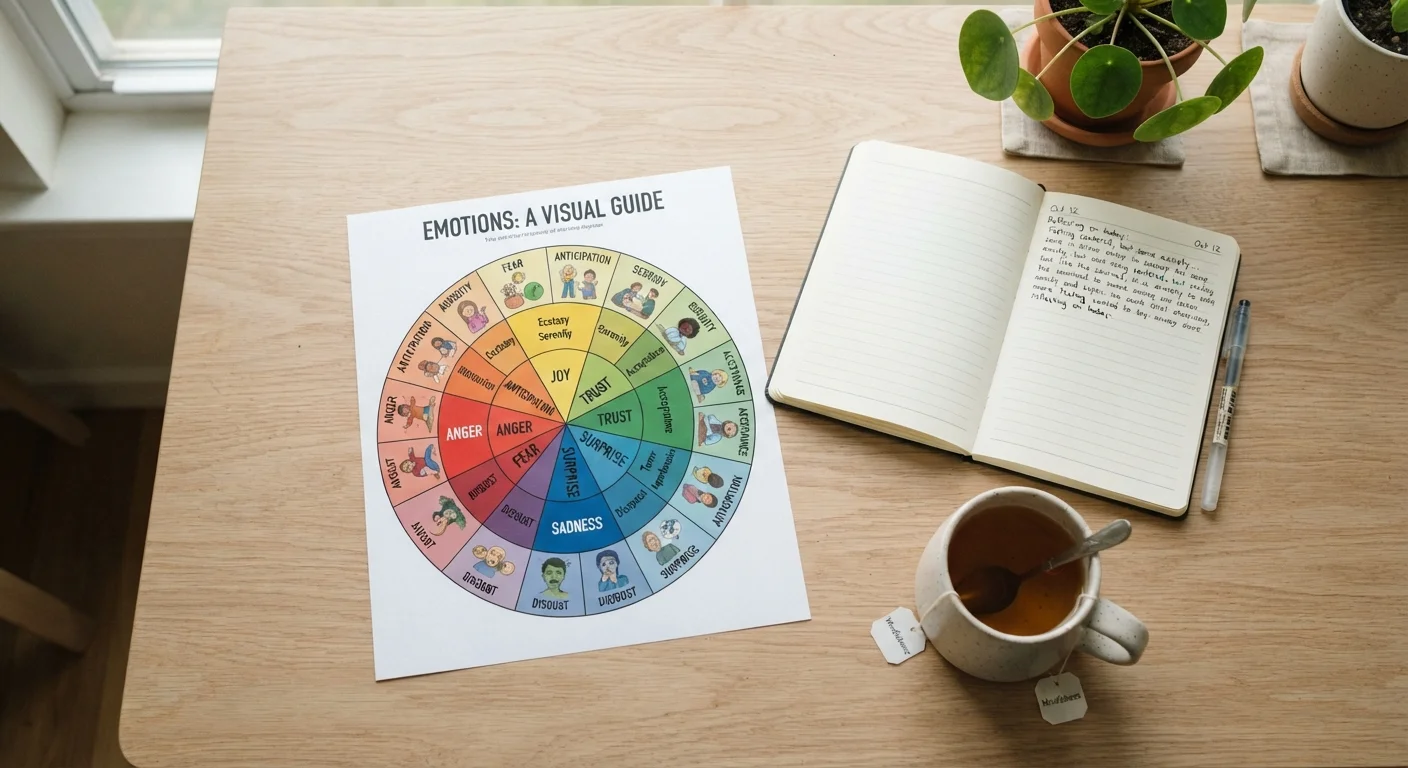
Understanding this mind-body link isn't just intellectually interesting — it's practically useful. When you can recognize the physical signature of an emotion, you gain earlier, clearer access to what you're actually feeling. And that's the first step toward responding rather than reacting. If you're still learning to name what you feel, the emotion wheel can be a helpful companion tool.
The Nervous System: Your Body's Emotional Relay
At the center of the body's emotional response is the autonomic nervous system (ANS) — the part of the nervous system that runs mostly below conscious awareness. The ANS has two primary branches: the sympathetic system, which prepares you for action (often called fight-or-flight), and the parasympathetic system, which supports rest and recovery.
When you perceive a threat — whether a car swerving toward you or a stressful email from your boss — the sympathetic branch fires. Adrenaline and cortisol surge. Heart rate climbs. Breathing shallows. Muscles tense. Digestion slows. These changes happen in milliseconds, long before conscious thought catches up. Your body has already decided something matters before your mind has named it.
This is why anxiety can feel like a tight chest or churning stomach even when you can't identify a clear reason for it. The body is responding to signals — internal or environmental — that the conscious mind hasn't fully processed yet. For a broader look at how these systems interact under stress, see our article on stress and anxiety from a whole-person perspective.
Try a Quick Body Check-In
When you notice a vague sense of unease or tension, pause and do a brief scan from head to feet. Ask: where in my body am I holding sensation right now? Is it tight, heavy, fluttery, or numb? Simply naming the location and quality of a sensation — without judging it — can help your brain begin to process the emotion underneath it.
Interoception: Reading Your Body's Emotional Language
The brain doesn't just send signals down to the body — it also receives a constant stream of information coming back up. This two-way conversation is mediated in part by what researchers call interoception: the brain's ability to sense and interpret the body's internal states, from heartbeat and breath to hunger and tension.
Interoceptive awareness varies from person to person. Some people are highly attuned to subtle internal signals; others barely notice them until they become intense. Research suggests that people with stronger interoception tend to have richer, more nuanced emotional awareness — they can distinguish between shades of discomfort more easily.
Interestingly, certain mental health conditions — including depression, anxiety disorders, and trauma-related conditions — are associated with disrupted interoception. Some people feel emotions too intensely in the body; others feel very little, a state sometimes called emotional numbness. Both patterns carry meaningful information about what the nervous system needs.
30+
Distinct bodily emotion maps identified in research
A widely cited Finnish study (Nummenmaa et al., 2013, PNAS) found consistent body-sensation maps for over 30 emotional states across diverse cultural groups.
~80%
Of nerve fibers in the vagus nerve carry signals upward
Researchers estimate around 80% of vagus nerve fibers transmit information from the body to the brain — underscoring how much emotional experience is built from bodily input.
2x
Higher risk of cardiovascular events linked to chronic emotional stress
Multiple longitudinal studies have associated sustained psychological stress with roughly double the risk of certain cardiac events, though causation involves many interacting factors.
When Physical and Emotional Signals Get Tangled
Because emotions produce real physical changes, it's common for people to notice body symptoms — fatigue, headaches, GI discomfort — without immediately connecting them to emotional causes. Likewise, physical illness can trigger or amplify emotional distress, creating a loop that can be hard to untangle without support.
Emotions that are habitually suppressed or avoided don't disappear — they tend to persist in the body. Chronic muscle tension, shallow breathing patterns, and a persistently activated stress response are all ways that unprocessed emotion can settle into the body over time. This isn't about blame; it's about biology. The body holds what the mind hasn't yet made sense of.
It's also worth noting that not all physical sensations signal distress. Positive emotions have distinct physical signatures too — warmth in the chest during gratitude, lightness in the limbs during joy, a sense of expansion with awe. Learning to recognize these signals enriches your emotional life in both directions.
For those building a more complete vocabulary for what they feel, exploring the difference between moods, emotions, and feelings can also clarify how these layers interact.
This article is for informational purposes only and is not a substitute for professional medical or mental health advice. If you're experiencing persistent physical symptoms or emotional distress, please consult a qualified healthcare provider.