
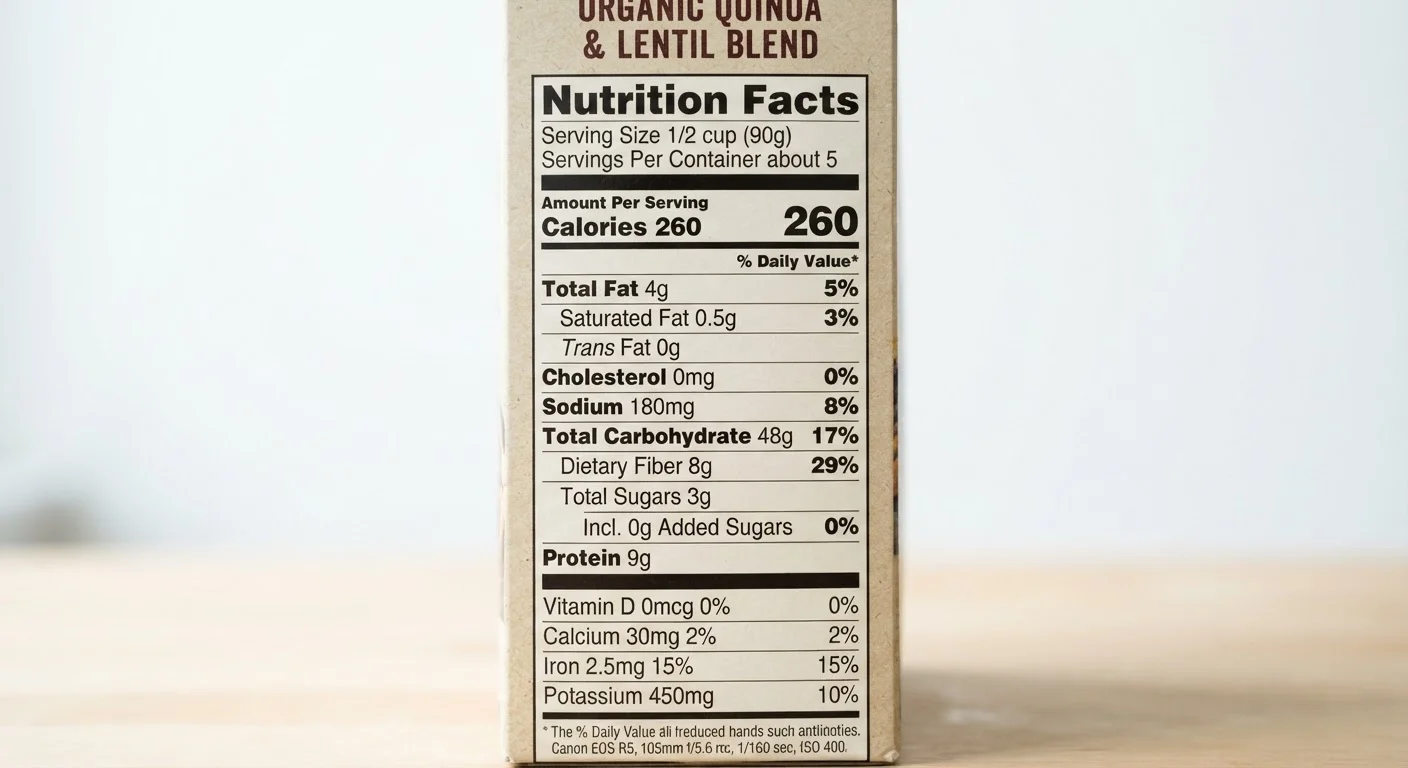
Why the Macronutrient Rows Matter Most
The Nutrition Facts panel is a standardized snapshot of what a food is made of. While many readers scan straight to calories, the three macronutrient categories — carbohydrates, protein, and fat — tell a richer story about how a food will fuel, fill, and affect you. Before you can use that story, you need a quick conceptual grounding. Our macronutrients quick-reference guide covers each macro's caloric value and physiological role if you need a primer.
The FDA's standardized label format means that no matter the brand or product category, the macro rows appear in the same order and use the same terminology. That consistency makes label reading a transferable skill. Once you understand the structure, you can apply it to any packaged food in seconds.
Consistency Is the Label's Greatest Asset
Because the FDA mandates a uniform label format for most packaged foods, the skill you build reading one label transfers directly to every other. Focus on understanding the structure once, and comparison shopping or quick nutritional assessments become much faster over time.
How to Read the Macronutrient Section Step by Step
Use the steps below with any packaged food in hand. Having a real label in front of you will make each instruction immediately concrete.
What you will need
Locate and confirm the serving size
Find the Serving Size line at the very top of the Nutrition Facts panel, just below the bold header. All gram counts for macronutrients on the label apply to this single serving — not the entire package. Check the number of servings per container (listed directly below) and compare it to how much of the product you actually plan to eat.
Read the Total Fat line and its sub-entries
Locate Total Fat and note the gram amount. Directly beneath it, indented, you will find two sub-categories: Saturated Fat and Trans Fat. These are portions of the total fat figure, not additions to it. Unsaturated fats (mono- and polyunsaturated) are sometimes listed here as well but are not required by the FDA on every label.
Read the Total Carbohydrate line and its sub-entries
Find Total Carbohydrate in grams. Indented beneath it are Dietary Fiber, Total Sugars, and — on labels updated to the current FDA format — Added Sugars. Fiber and sugars are components of total carbohydrate, so they do not add to it. A food with 30 g total carbohydrate, 5 g fiber, and 10 g total sugars has 15 g of other carbohydrates (starches, for example).
Read the Protein line
Find Protein and note the gram count. Unlike fat and carbohydrates, protein has no required sub-entries on the standard Nutrition Facts panel — the number stands alone. Protein's primary roles include tissue repair, enzyme production, and satiety support.
Cross-check macros against total calories
Using the calorie-per-gram values — 4 kcal per gram for carbohydrates and protein, 9 kcal per gram for fat — mentally estimate the calorie contribution from each macro. Multiply grams by the appropriate factor and add them together. The result should approximate (within a few calories) the Calories figure at the top of the label. This cross-check builds intuition for how macros drive a food's energy density.
Once you've worked through the label, consider how that food's macro profile fits into the broader meal. Our guide on building a macro-aware meal without counting every gram shows how to use this awareness practically, without obsessive tracking.
Interpreting What You Find
Raw gram counts mean more when you understand the context. Fat contains roughly twice the calories per gram as carbohydrates or protein, so a food with 15 g of fat contributes significantly more energy than 15 g of carbohydrate — even though the gram weights look identical. This is why calorie counts can be high even when portion sizes look modest.
Within the carbohydrate line, the fiber sub-entry reflects carbohydrate that is largely not digested for energy but supports gut health and satiety. The sugars sub-entry — and particularly the added sugars line introduced in the updated label format — helps distinguish natural sugar content (as in dairy or fruit) from sugars added during processing. The whole foods vs. processed foods guide explores how processing relates to added sugar and ingredient quality more broadly.
Within fat, saturated fat and trans fat are separately listed because dietary guidance treats them differently from unsaturated fats. Current USDA Dietary Guidelines advise limiting saturated fat and avoiding industrially produced trans fats where possible. The label makes both visible at a glance.
Gram Counts Reflect One Serving Only
Every macronutrient figure on the label — fat, carbohydrates, protein — corresponds strictly to the listed serving size, which may be much smaller than a typical portion. Consuming more than one serving multiplies all values proportionally. Failing to account for this is one of the most common and consequential label-reading errors.
Different eating patterns deliberately emphasize different macro proportions. If you're curious how the numbers on a label translate into broader dietary frameworks, see our article on macronutrient ratios across different eating patterns. And while macros dominate the label's midsection, the lower portion lists vitamins and minerals — a separate but complementary layer of nutritional information covered in our vitamins and minerals hub.
This article provides general nutrition education and is not a substitute for personalized advice from a qualified healthcare or registered dietitian professional.