Two Categories, Four Stages
Sleep is not a single, uniform state of unconsciousness. From the moment you close your eyes to the moment you wake, your brain moves through a carefully sequenced series of stages — each with its own brain wave signature, physiological hallmarks, and biological purpose.
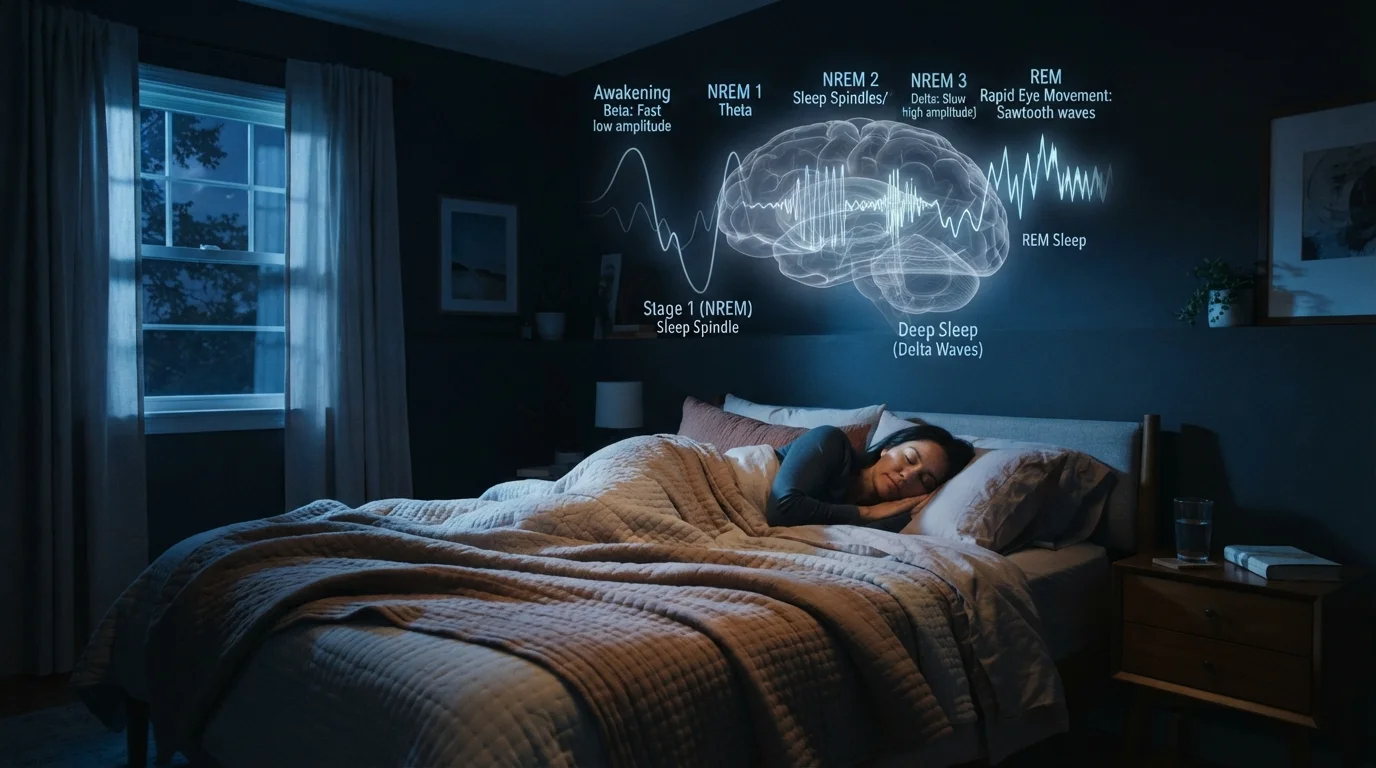
These stages fall into two broad categories. NREM (non-rapid eye movement) sleep comprises three stages — often labeled N1, N2, and N3 — that progress from light drowsiness to the deepest, most restorative sleep your body achieves. REM (rapid eye movement) sleep follows, characterized by a brain that looks surprisingly awake on an EEG scan, rapid eye movements beneath closed lids, and vivid dreaming.
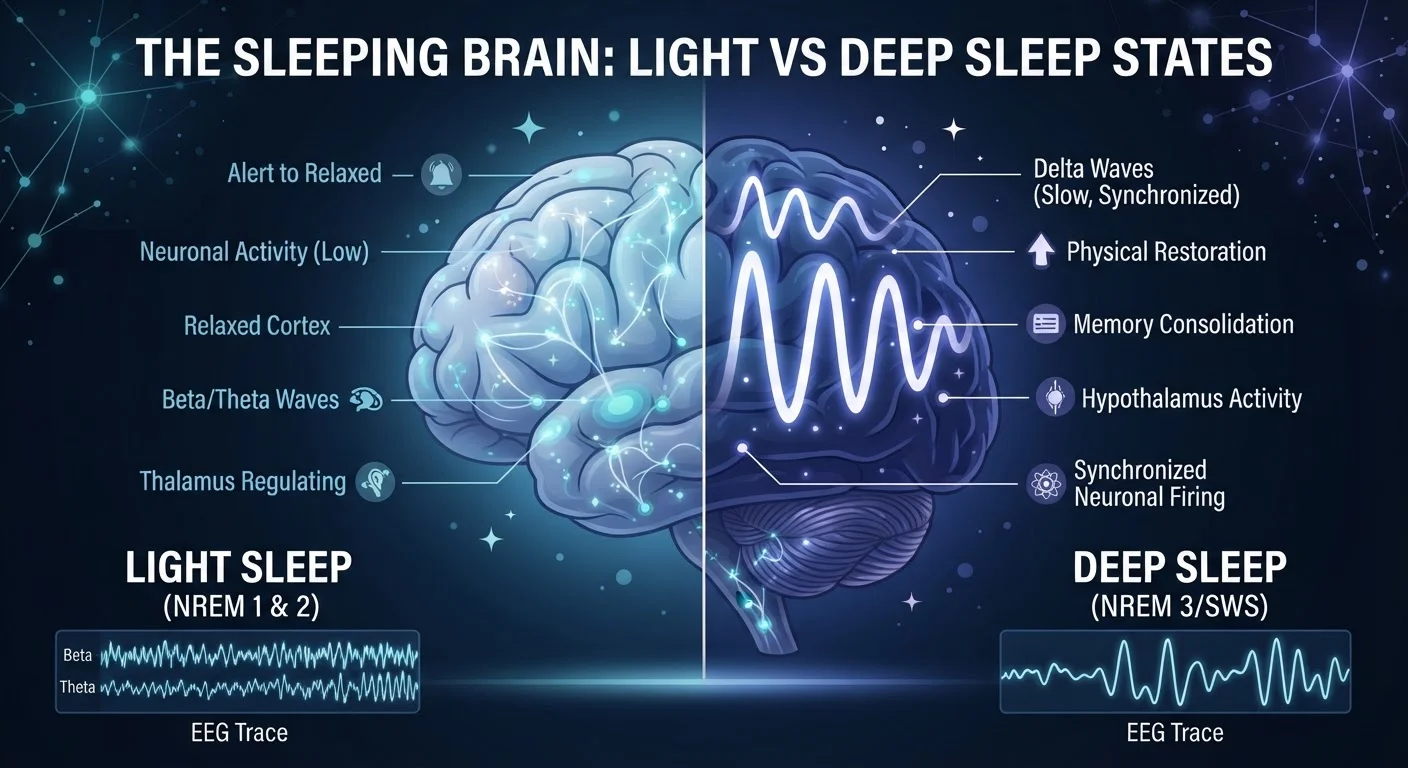
Together, NREM and REM stages form one complete sleep cycle lasting roughly 90 minutes. For a full night's sleep, most adults move through four to six of these cycles. For a closer look at what distinguishes light from deep sleep within NREM, see Light Sleep vs. Deep Sleep.
Inside NREM: From Drowsiness to Deep Restoration
N1 — the lightest stage — is the brief threshold between wakefulness and sleep. Brain activity begins to slow, muscles may twitch (a phenomenon called hypnic jerks), and the mind drifts into a semi-conscious state. N1 typically lasts just a few minutes and is easily interrupted.
N2 makes up the largest proportion of a night's sleep — roughly 45–55% in healthy adults. Brain waves slow further, body temperature drops, and heart rate decreases. Two hallmark features appear: sleep spindles (short bursts of oscillatory brain activity) and K-complexes (large, sharp wave patterns). Research suggests sleep spindles play a role in consolidating procedural memories — skills and habits rather than facts.
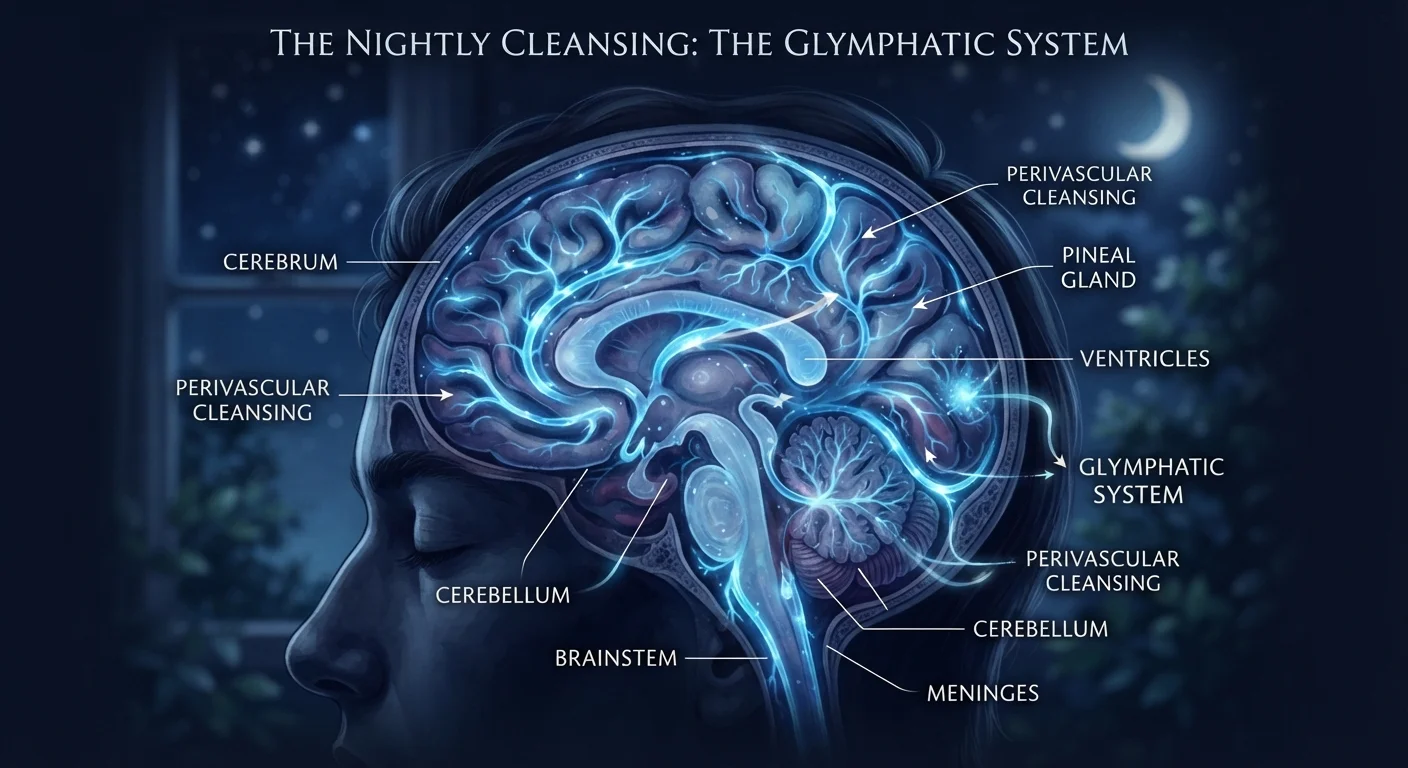
N3, commonly called deep sleep or slow-wave sleep, is the most physically restorative stage. Delta waves — the slowest brain waves measurable — dominate this phase. The pituitary gland releases growth hormone, tissue repair accelerates, and the immune system strengthens. N3 is also when the brain's glymphatic system is most active, flushing out metabolic waste products accumulated during waking hours. Learn more about that process in The Glymphatic System.
20–25%
Proportion of sleep spent in REM
In healthy adults, REM sleep typically accounts for roughly 20–25% of total nightly sleep, according to established sleep science research.
45–55%
Proportion of sleep in N2 stage
N2 is the most prevalent single sleep stage across a full night, forming the backbone of the sleep cycle in typical adults.
90 min
Average length of one full sleep cycle
Each complete NREM-to-REM cycle lasts approximately 90 minutes, with four to six cycles making up a standard night's sleep.
REM Sleep: The Brain's Nightly Workshop
REM sleep was first identified in the early 1950s by researchers Nathaniel Kleitman and Eugene Aserinsky, who noticed periods of rapid eye movement in sleeping subjects accompanied by brain activity resembling wakefulness. The finding was foundational — it proved that sleep was not passive but dynamically organized.
During REM, the brain is highly active. Most skeletal muscles are temporarily paralyzed (a state called atonia), which is thought to prevent people from physically acting out their dreams. Blood flow to the brain increases, and emotional processing intensifies. The majority of vivid, narrative dreaming occurs in REM.
Critically, REM sleep is linked to memory consolidation — particularly the integration of emotionally significant experiences and complex learning. Studies consistently show that REM deprivation impairs performance on tasks requiring pattern recognition, creative problem-solving, and emotional regulation.
“Sleep is not simply the absence of wakefulness. It is an active, organized process during which the brain performs essential work it cannot do while we are awake.”
— Matthew Walker, Professor of Neuroscience and Psychology, University of California, Berkeley
The distribution of REM across the night is uneven: early sleep cycles contain very little REM — sometimes only a few minutes — while cycles in the final hours of sleep are rich in REM. This is why cutting sleep short by even an hour or two disproportionately reduces REM exposure.
Why the Cycle Rhythm Matters
The sequencing of sleep stages is not arbitrary. The brain moves through them in a specific order — N1, N2, N3, back to N2, then REM — before beginning the cycle again. Disrupting this rhythm, whether through inconsistent sleep timing, environmental disturbances, or substances like alcohol, degrades the quality of each stage even when total sleep time appears adequate.
Your body's internal clock — the circadian rhythm — plays a central coordinating role, signaling when each stage is most likely to occur. Understanding your circadian rhythm can help explain why irregular sleep schedules fragment architecture so effectively.
External factors matter too. Bedroom temperature, light levels, and noise all influence how smoothly your brain transitions between stages. For a comprehensive look at what's happening in your body across all of these stages, see What Actually Happens to Your Body While You Sleep.
This article is for general informational and educational purposes only and does not constitute medical advice. If you have concerns about your sleep quality or suspect a sleep disorder, please consult a qualified healthcare professional.